Tag Archives: Italy

An Amazing New Ending to an Incredible Journey: Pietrabbondante, The Town

21 Sep

On October 21, 2013, I began a “journey” with my paternal grandfather, Alexander Capraro, via letters he wrote home to my grandmother, Modesta Rose (Maude). He was returning to Europe in 1938 for the first time since he left for America at age four with his parents and younger sister. 

©blogginginitaly.com

My final post of that series, written on July 3, 2014, was about Len and my reaching his birth town, Pietrabbondante, and finding his birth home… or so I thought! 

For those seeking information about your ancestors, my advice is to never give up. As you will see, in this and several posts to follow, TEN YEARS LATER, my new incredible “ending” has become an extended awareness of our family history as well as the beginning of wonderful new familial connections. 

Len and I returned to Pietrabbondante September 14-16, 2024, for an incredible recognition of my grandfather. But first, some expanded information I learned about the town and its history.

When my grandfather visited in 1938, he described Pietrabbondante in his letter home:

“The town has about 4000 people, electric light, and a secondary railroad. It is well named for the mountain peaks of stone and rocks… The scenery is beautiful beyond imagination.”

©blogginginitaly.com


©blogginginitaly.com

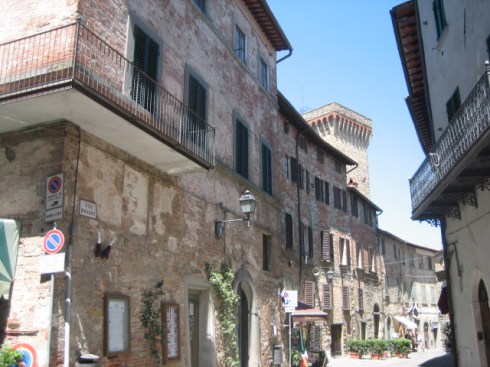
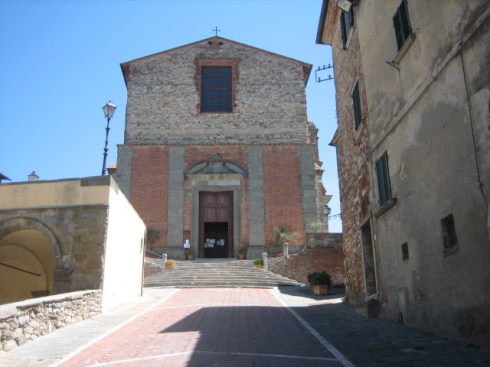
Today, the full time population is less than 200, but expands greatly during holidays and summer months. As with large and small towns throughout Italy, the annual cultural and religious festivals and celebrations are always on the calendar. There are no longer schools or restaurants in town, but among the places I noticed on my walk were two bars, two groceries, two butcher shops, a tabacchi, a post office, a pharmacy, a barber, a beauty salon, the church, and the municipal building.  Some of these are pictured below. 

©blogginginitaly.com
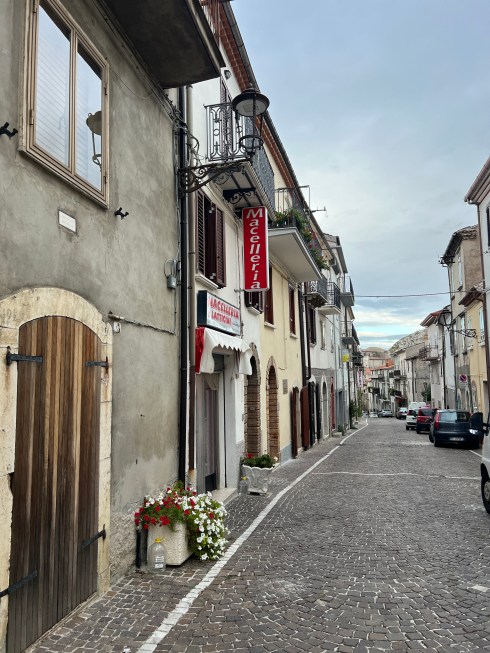

©blogginginitaly.com


©blogginginitaly.com
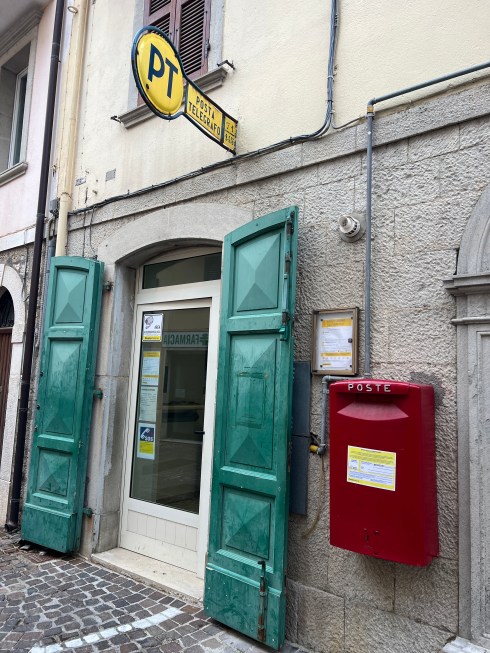

©blogginginitaly.com


©blogginginitaly.com


©blogginginitaly.com    Church of Santa Maria Assunta


©blogginginitaly.com     Pietrabbondante Municipio

Pietrabbondante is located in the province of Isernia, (Molise region), a two hour train ride from Rome. Interestingly, when my grandfather was born in 1895, the town was part of the Abruzzo region. (Seems like redistricting happens everywhere!)

Looking closely at the monument above, you’ll see a statue depicting an ancient Samnite soldier. This statue is a tribute to the fallen soldiers from Pietrabbondante in WWI. The funds for the statue were raised by an immigrant committee in America in 1919, and in 1920, the local city council used the funds to construct the monument.

But why a Samnite soldier, and who were the Samnites? More about the ancient history of Pietrabbondante in the next post.

For now, I’ll leave you with a short lesson in Italian:
Pietrabbondante = pietra [stone] + abbondante [abundance].
As my grandfather said, it is well named indeed!

Ciao, 
Judy 

Continue reading

Fighting a Cold (raffreddore)

9 Oct

In October, when the night air turns cooler but the days are still warm, Tuscan colds are a plenty. The locals blame it on the change in weather and I’m becoming a believer. But when the sky is bright blue and the weather is in the 70’s, it’s hard to nurse a cold in bed. 

Still, not wanting to spread my germs, we headed to Lago Trasimeno for a walk and lunch. We were also curious about the lake level due to both the summer drought and more recent rains.

What we found didn’t surprise us as Umbria and Tuscany sustained spring and summer months with virtually no rain and intense heat. The lake had not only receded, it actually uncovered sandy beach areas we had never seen before.

IMG_0451

©blogginginitaly.com

IMG_0443

©blogginginitaly.com

After our walk, we stopped at a caffé for a light lunch, but more so to sit in the warm sun and be mesmerized by the clouds dancing on the ripples across the lake.

IMG_0450

©blogginginitaly.com

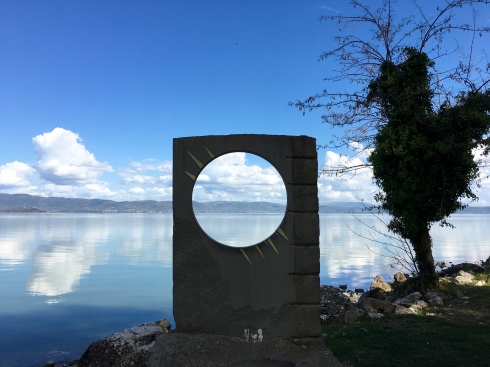
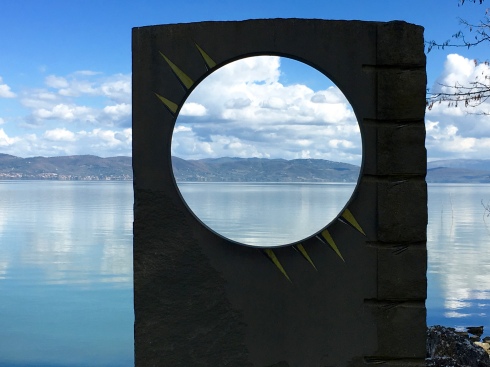
Walking back to the car, I couldn’t help but stop at this structure for a few more photos.

IMG_0445

©blogginginitaly.com

IMG_0446

©blogginginitaly.com

Tonight for dinner, we made a red and yellow pepper risotto that turned out quite well. 

IMG_0471

©blogginginitaly.com

All in all, a perfect way to not have a cold ruin a beautiful day! 

Ciao,
Judy

Festa della Liberazione

25 Apr

In Italy, April 25th is a national holiday celebrating the country’s liberation from Nazi occupation in 1945.

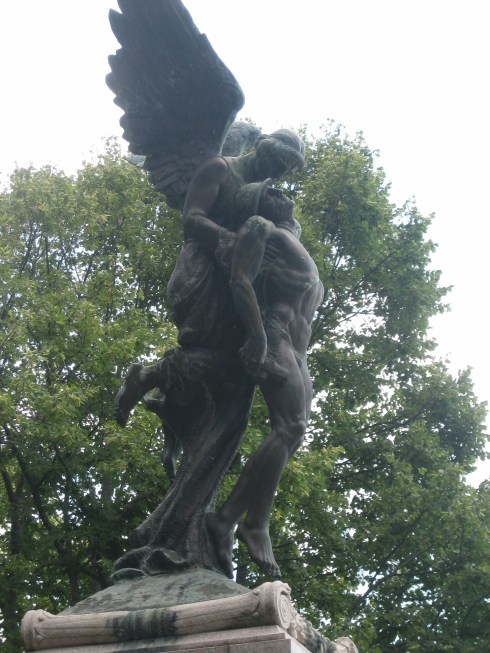
Although it is quite chilly in Cortona, the band marched through the streets and placed a wreath  at the statue dedicated to those who fought and died for freedom.

©Blogginginitaly.com

©Blogginginitaly.com

An important day to remember, especially for those of us who love being in Italy.

Ciao,
Judy

Lucignano Tuscany

10 Apr

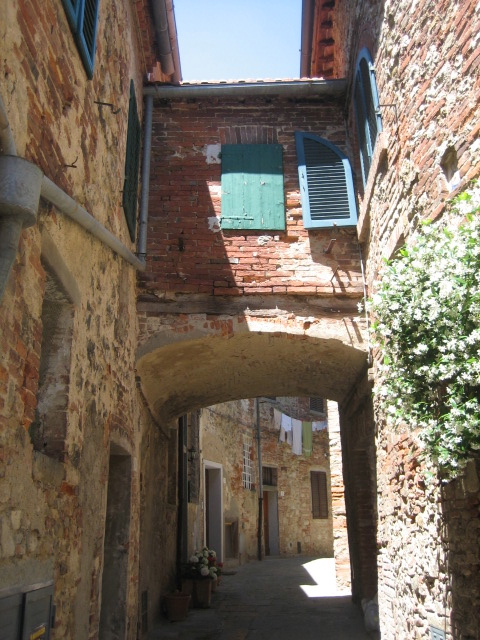
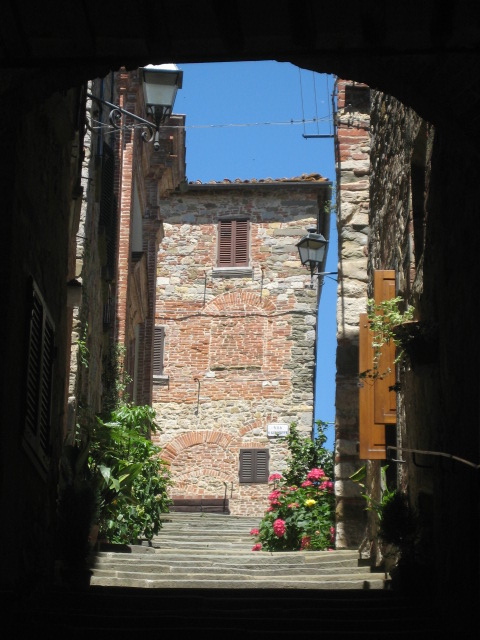
Yesterday, Len and I took a ride to the lovely town of Lucignano with friends. It was a nice spring day and I think we were the only visitors in town. In fact, it seemed as though we were the only people in town.

©Blogginginitaly.com

©Blogginginitaly.com

When we parked the car, I realized we had briefly visited here 5 years ago. This post includes some of the research from my original post, with some updates and some new photos.

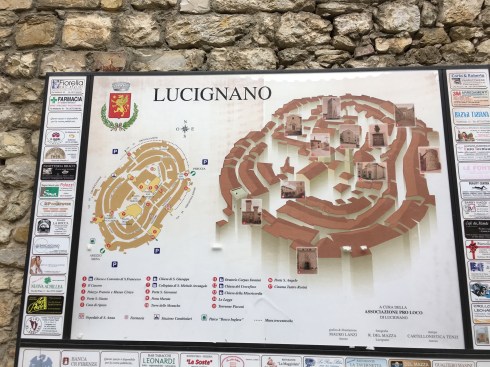
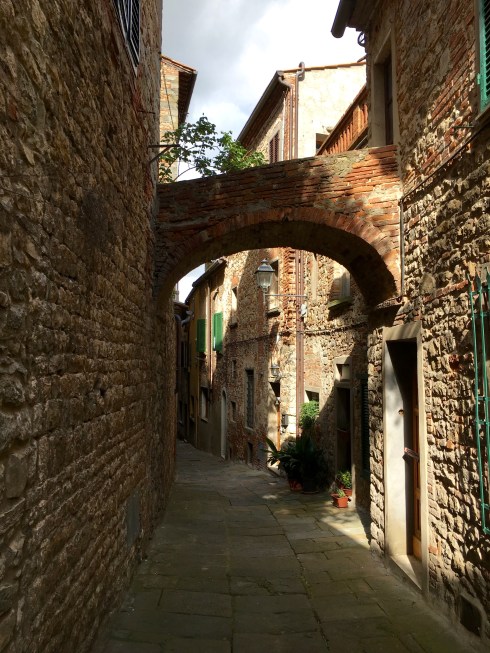
Lucignano, a remarkably preserved medieval walled village, is laid out in elliptical rings.

©Blogginginitaly.com

©Blogginginitaly.com

This beautiful town sits 414 metres above sea level and offers its visitors a trip back in time.

©Blogginginitaly.com

©Blogginginitaly.com

©Blogginginitaly.com

Although Lucignano sits between Siena and Arezzo, it came under Florentine control in the 1500s, when a great deal of construction ensued. Today, one can still see the Puccini’s Fortress; Vasari’s 1568 sanctuary of Madonna della Querca; the Cappucini convent, c.1580; and several churches including Piazza S. Francesco with the church of S. Francesco in the background, and

©Blogginginitaly.com

©Blogginginitaly.com

Chiesa della Collegiata, c.1594.

©Blogginginitaly.com

©Blogginginitaly.com

©Blogginginitaly.com

©Blogginginitaly.com

IMG_5970

©Blogginginitaly.com

In addition, the Museo Civico, left, offers many artistic treasures including the L’albero della vita, or tree of life, a gilded and jeweled tree holding a crucified figure.

©Blogginginitaly.com

©Blogginginitaly.com

©www.comune.lucignano.ar.it

©www.comune.lucignano.ar.it

On the village’s website, http://www.comune.lucignano.ar.it,  Lucignano is described as “a pearl of the valdichiana, a small village that represents one of the more extraordinary examples of medieval urban planning for its system of elliptic rings…” Today, the village continues its agricultural and artisan traditions and produces products ranging from olive oil and honey to ceramics and gold jewelry. In addition, should you wish to purchase inlaid furniture or have a piece in need of repair, the skilled artists of Lucignano are ready to oblige.

©Blogginginitaly.com

©Blogginginitaly.com

©Blogginginitaly.com

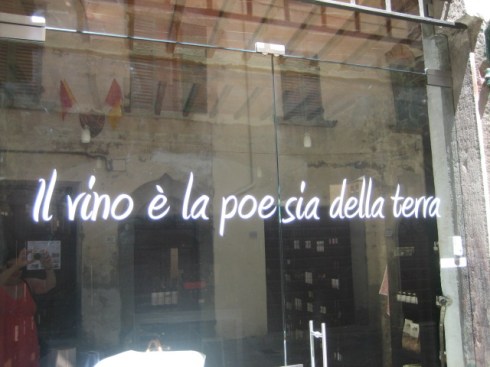
Five years ago, we saw this written on the window of a wine shop, and I was happy to see it again.

IMG_5959

Wine is the poetry of the earth

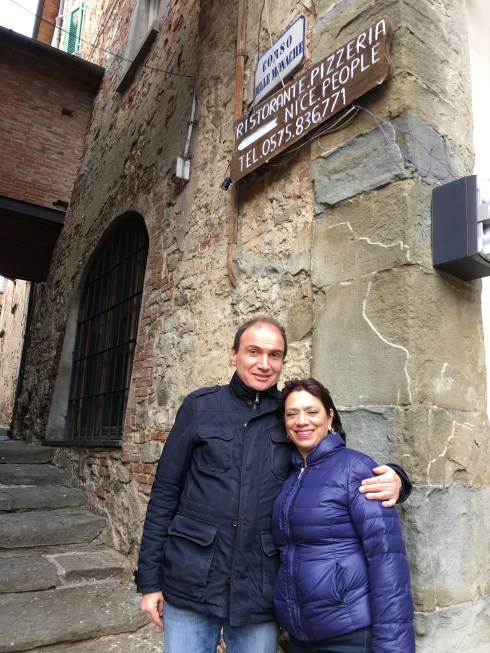
And five years ago, we found this sign, but not the restaurant.

IMG_5969

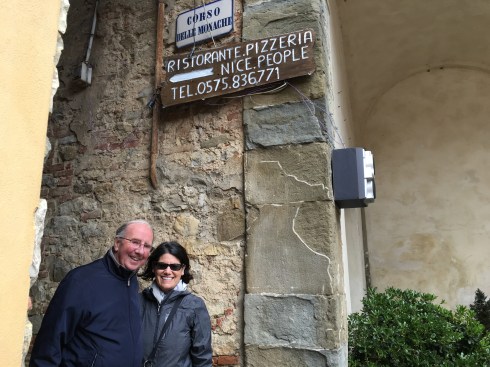
This time, we found the restaurant, and although it was closed, we found the nice people.

©Blogginginitaly.com

©Blogginginitaly.com

©Blogginginitaly.com

©Blogginginitaly.com

A wonderful way to spend the afternoon, strolling with friends through a beautiful ancient city, rich with history and culture…

©Blogginginitaly.com

©Blogginginitaly.com

making new friends,

©Blogginginitaly.com

©Blogginginitaly.com

and not even needing to close the door on our way out.

©Blogginginitaly.com

©Blogginginitaly.com

Ciao,
Judy
Feast of the Italian Liberation

24 Apr

Festa della Liberazione – April 25th – a day dedicated to celebrating Italy’s liberation from Nazi occupation during World War II.

If you happen to be in Italy and hear a great deal of noise overhead, it is probably the Frecce Tricolori or the Three Color Arrows. Or if you hear a lot of music and cheer, you may just find yourself in the middle of a parade! In either case, a great cause for celebration.

Rivolto

Rivolto (Photo credit: Wikipedia)

Italiano: Frecce Tricolori all'Air Show di Fal...

Italiano: Frecce Tricolori all’Air Show di Falconara Marittima, Ancona, Italy. (Wikipedia)

I migliori auguri – my very best wishes – to my Italian friends…we raise a toast to you and your freedom!

Ciao,

Judy
More Rome

18 Feb

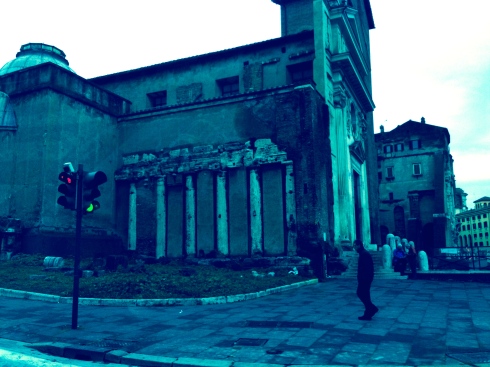
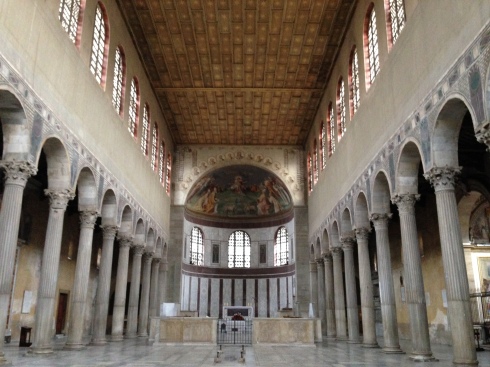
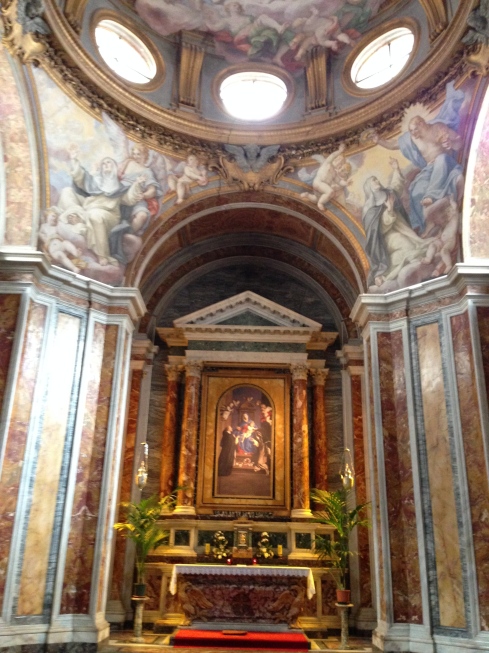
My last two days in Rome brought some incredible experiences. I spent Tuesday with Roman locals, the parents of a friend from Austin. Giovanna picked me up Tuesday morning and we did a whirlwind tour around Rome. We began the day at The Church of Santa Sabina on the Aventine Hill in Rome, the oldest surviving Roman basilica.

IMG_1520

IMG_1519

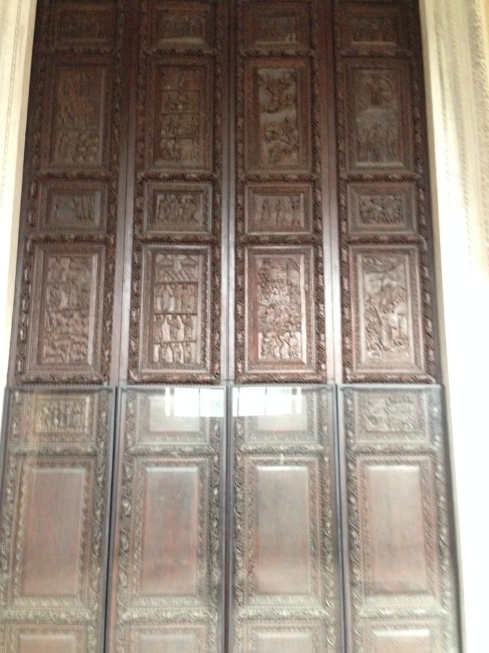
It is famous for its cypress doors, which may date to the early 5th century when the church was built, and are said to contain the first depiction of the crucifixion of Jesus.

IMG_1522

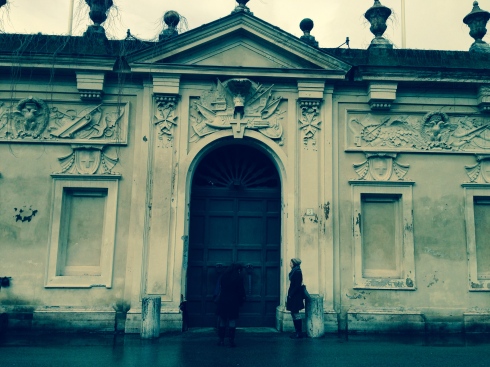
From there we drove to the Villa del Priorato di Malta, home to the Grand Priory in Rome of the Sovereign Military Order of Malta, which remains a sovereign entity. IMG_1528

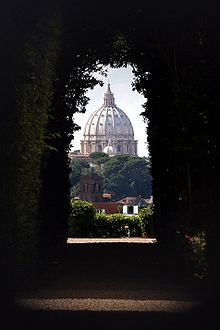
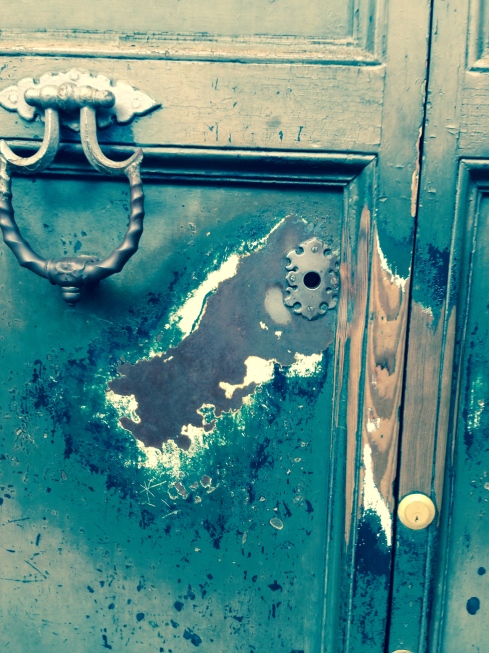
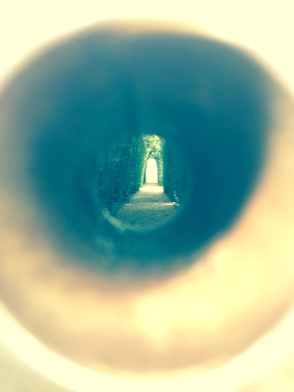
The Villa may be best known for a keyhole in the door

IMG_1527

through which you can clearly see Saint Peter’s Basilica, far across the city. The first photo is from my phone; the second shows exactly what you see through the keyhole.

IMG_1526

220px-StPetersBasilica_Keyhole_2

wiki photo

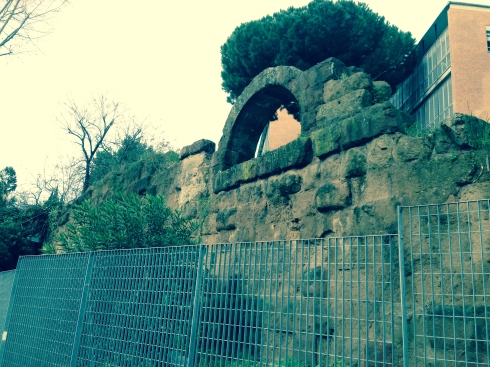
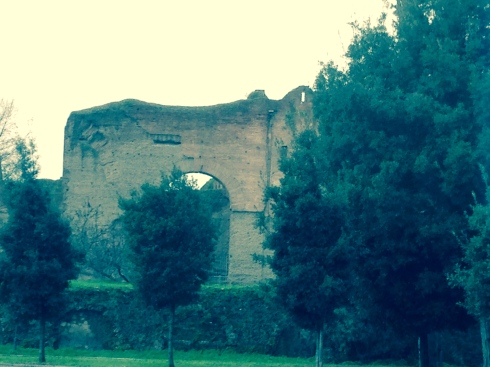
From there, we saw part of the original Roman Wall called the Servian Wall, sections of which are still visible in various locations around Rome. The Servian Wall was a defensive barrier constructed around the city of Rome  in the early 4th century BC.

IMG_1532

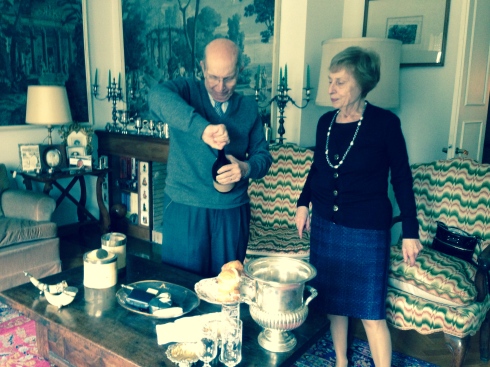
Next on to lunch at my “guide’s” home. What a thrill it is for me to be invited into the home of local Romans and share in their passion for all things Italian. I was introduced to Giovanna’s husband and together we shared wonderful conversation and the most delicious lunch, beginning with Champaign in the drawing-room.

IMG_1534

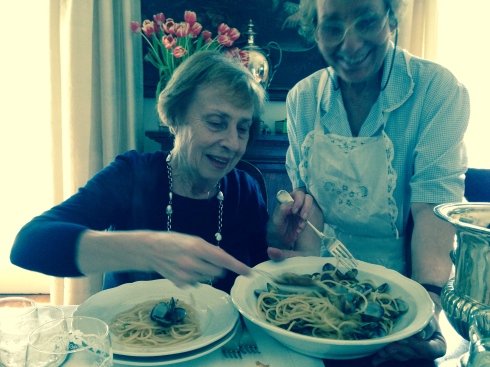
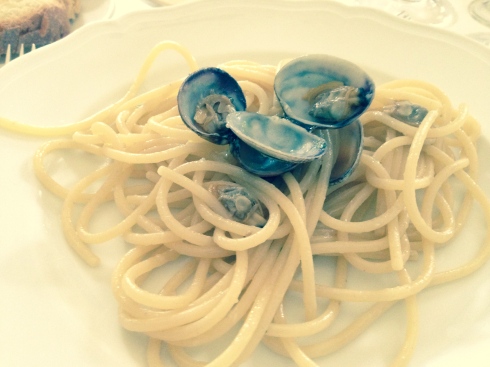
From there, we moved to the dining room and were treated to Spaghetti con vongole

IMG_1540

IMG_1537

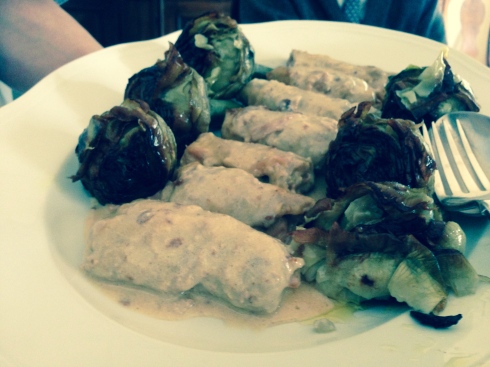
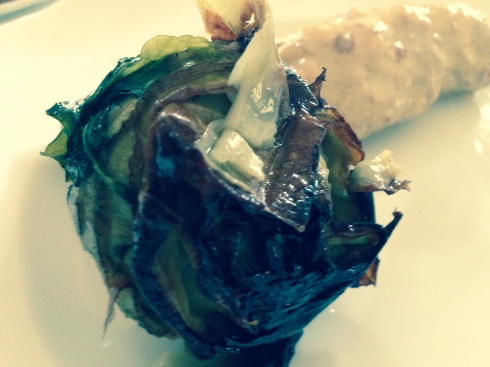
Sicilian artichokes and a rolled meat and cheese dish (sorry I don’t know the name!)

IMG_1541

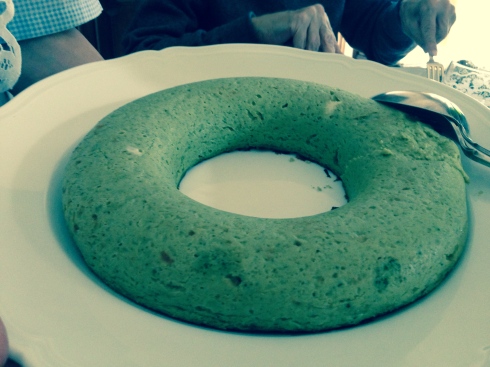
IMG_1542A beautiful vegetable terrine

IMG_1543

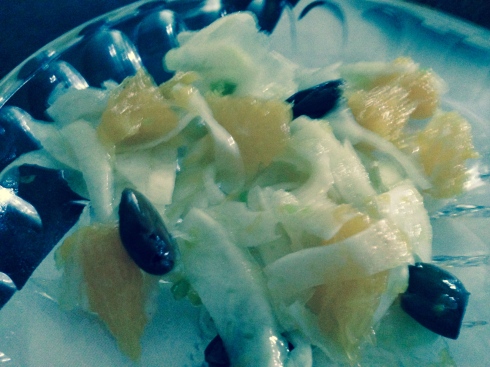
Fennel saladIMG_1544

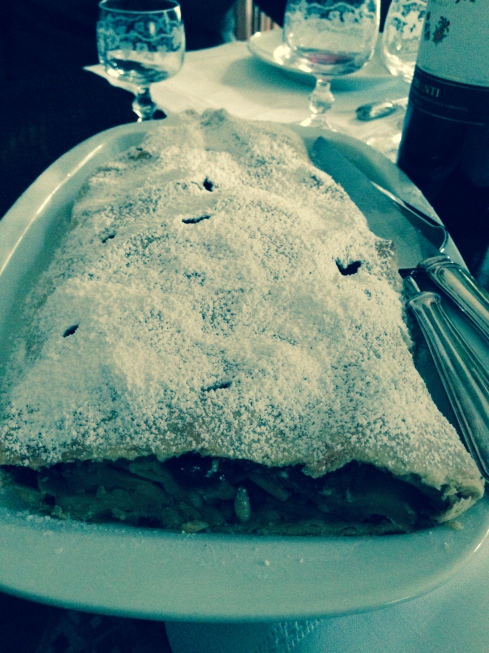
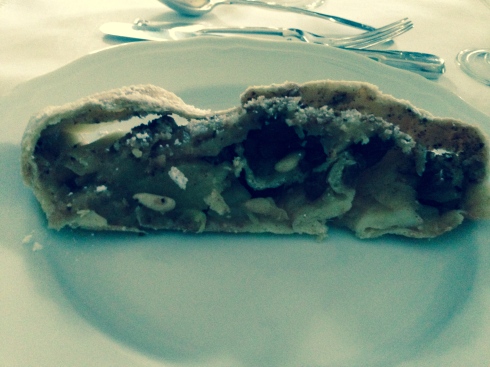
and homemade apple torta!

IMG_1545

IMG_1546

We conversed easily in both Italian and English and spent a great deal of time talking about places and treasures to visit in Italy.

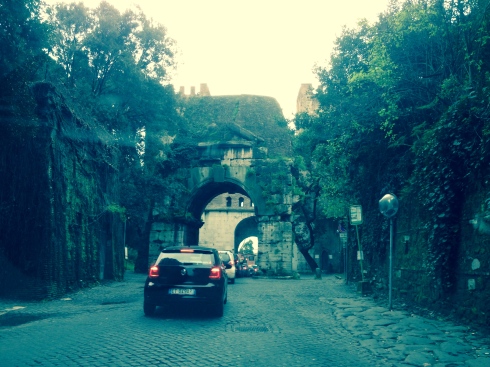
After lunch, more of my tour. First up was a ride along Appia Antica, or as you may know it, the Appian Way. IMG_1550

IMG_1552

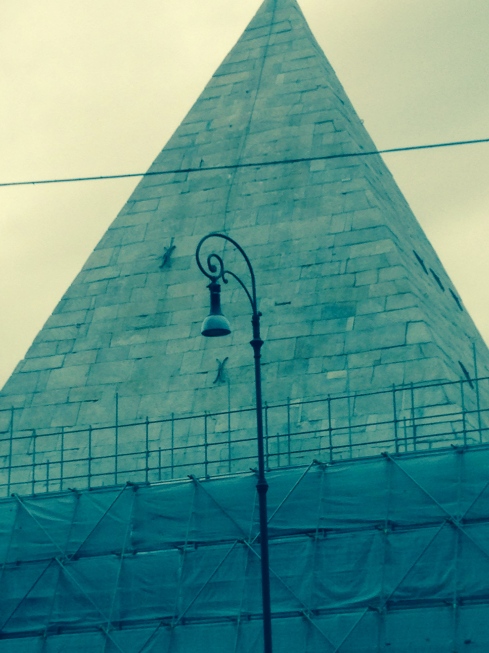
From there we drove to the Pyramid of Cestius, built around 18BC-12BC as a tomb for magistrate Gaius Cestius. At the time it was built, it lay in the open countryside as tombs were not permitted within the city walls.

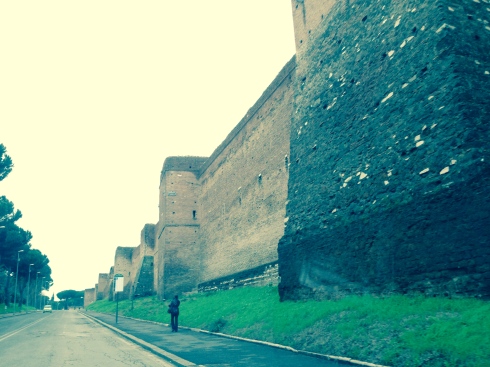
IMG_1557The pyramid was incorporated into the Aurelian Walls, close to Porta San Paolo.

IMG_1554

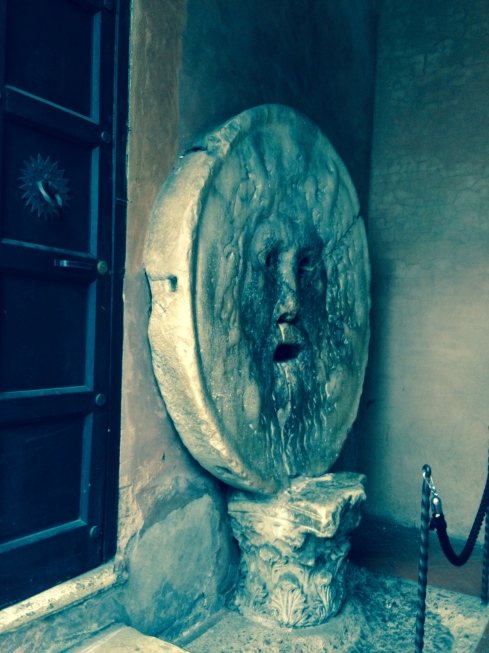
Up next, La Bocca della Verità, aka The Mouth of Truth. This ancient Roman marble disc displays a carving of a man-like face and is thought to have been part of a first century fountain or even a manhole cover. Legend has it that if you tell a lie, and put your hand in the mouth, it will be bitten off. So be warned! During the 17th century, it was placed in the portico of Santa Maria in Cosmedin, the church which is home to relics of St. Valentine.

IMG_1562

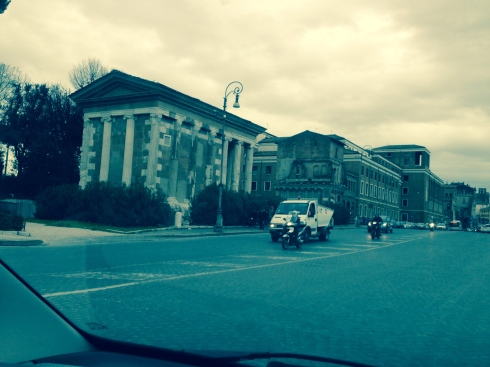
And finally, on to ancient temples before heading home.IMG_1563

IMG_1564

What an amazing day I had, with my ever hospitable and knowledgeable private tour guide and now new friend.

And to think we did all that in this:

IMG_1565

Giovanna, grazie per una giornata meravigliosa e una ricorderò sempre!

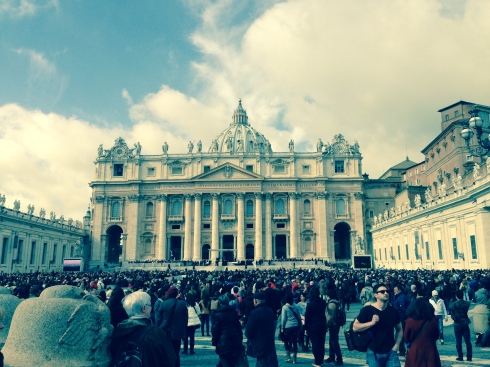
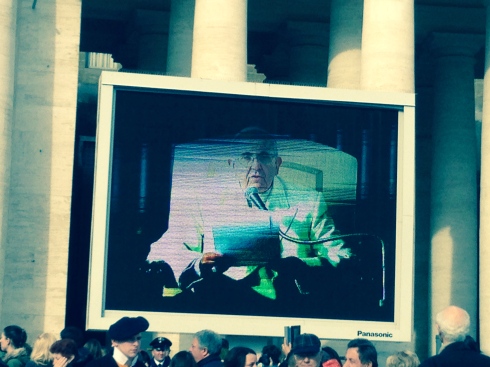
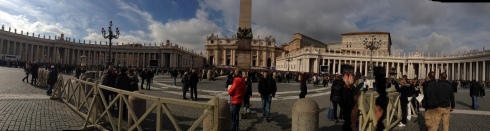
That was Tuesday, and I still had one day left in Rome. What better thing to do than attend a Papal audience.  So that I did, Wednesday morning, along with about 12,000 others, but who’s counting!

IMG_1582

IMG_1578

IMG_1575

IMG_1583

Arrivederci Roma once again. You never fail to amaze. Till next time.

Ciao,

Judy
Through His Words: Day Six

28 Jan

Reflections From and About My Grandfather
Alexander Capraro, Architect

Day Six:

Thursday, July 21, 1938 
On board ship        
Chapter 6

Hello Darling,

This was a very busy day. Got up at 5:00 a.m. to see the sunrise. What a beautiful sight to behold, a great big ball of fire suddenly coming up out of nowhere with its rays reflected in the shimmering silver on the ocean. There is something fascinating about the ocean, what it is I do not know, but it brings a feeling of regret that soon we will be on land while at the same time wishing to get away from it (the ocean). 

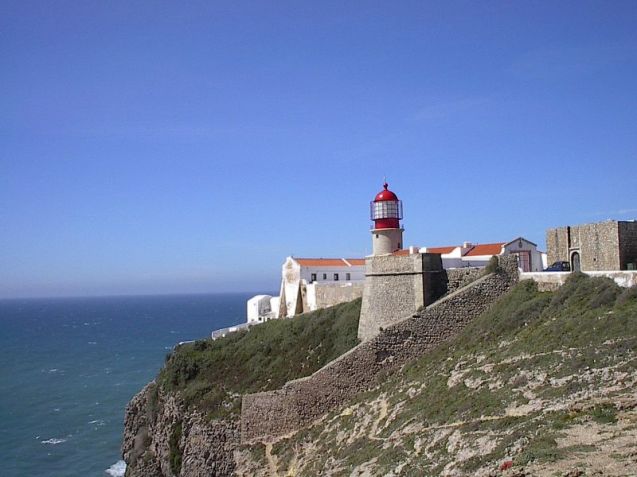
I met Fr. Peoria on deck and we took a real workout together walking about two miles, then turned in, took a shower, and had breakfast later. Soon we were to see what is known as St. Vincent’s Light, a light house on the south tip of Portugal…

The 79 foot lighthouse was built in 1846 over the ruins of a 16th-century Franciscan convent. It is one of the most powerful lighthouses in Europe overlooking one of the world’s busiest shipping lanes. Its lamps can be seen up to 37 miles away.

800px-Cabo_São_Vicente

Photo: Wiki commons

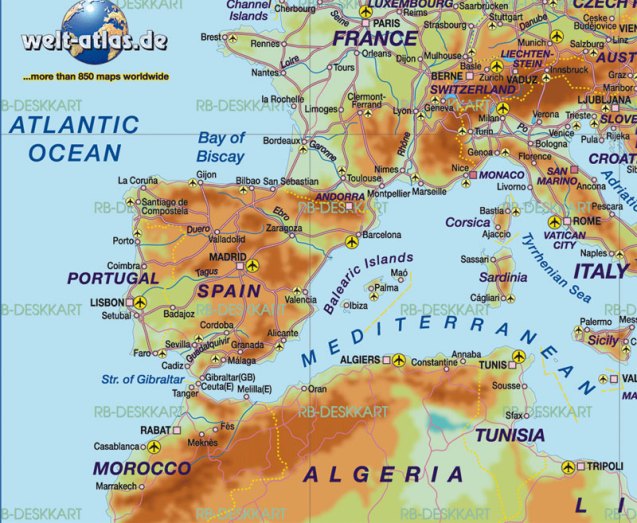
then see the south coast of Portugal and Spain and the north coast of Africa.

gibraltar-area

welt-atlas.de

The town of Tangier could be seen on the tip of Africa, then follows the African coast and by 9:00 p.m., looms the Rock of Gibraltar.  It is dark now and millions of lights from the city play on the water off the Straights of Gibraltar.

If you study the map, you can follow the ship’s course, heading east past Tangier (Tanger) through the Straights of Gibraltar en route to Naples; and if you close your eyes, you can just imagine the spectacle of lights dancing on the water that dark and beautiful night.

Powerful searchlights guide us to our location where we anchor and then a tender, another boat much smaller, comes up to ours to take off passengers getting off at Gibraltar. Battleships and submarines all around us – English, French, Italian and American. 

His last line, so calm, is amazing when you think of what was happening in the world in 1938. Tension between Germany and Czechoslovakia was growing; hostilities between China and Japan were raging; Hitler had sent his armed forces into Austria; and Italy, under Mussolini, had joined Germany and Japan in the Anti-Comintern Pact.

Small boats come up to our boat selling all kinds of junk to the passengers. These vendors throw up to our deck a rope with a basket tied to the end. This basket contains the articles they are selling. You ask, “How much?” They say, “$2.00.” You offer .50c and you settle for a dollar or less.

Soon the ship is ready to move. The small boats row away and we continue on between the coasts of Spain and Africa, a beautiful sight. We go on following the African coast, avoiding the Spanish coast.

When I first saw my grandfather’s passport, one page was puzzling to me. On page 5, Limitations, the following was stamped in red:

This passport is not valid for travel in Spain.

photoWith a little research,  I learned that Americans were not permitted in Spain in 1936 as it was consumed by  war, The Spanish Civil War, which would end in 1939 with General Franco prevailing. Franco would go on to rule Spain for 36 years until his death in 1975.

It is starting to get warmer as we are going farther south. We now start to see other ships for the first time since we left NY; every type of boat. We are in the Mediterranean, blue waters, large fish in schools jumping out of the water. For the first time, I actually saw “flying fish” – they fly about 10-20 ft out of the water and keep on until their “wings” dry out and they fall in the water again.

WAFR-00012339-001

According to the BBC – 2014, “Flying fish actually glide rather than truly fly. They launch themselves into the air by beating the tail very fast and spreading their pectoral fins to use as wings. There are 52 different species of flying fish which are found in the Indian, Atlantic and Pacific Oceans.”

We are now on our way to Naples, 1000 miles away, and will arrive about 1:30 p.m. Maude, I just can’t believe all this is an actuality; the whole thing seems like a dream. Last thing on the ship activities was in the swimming pool. They called it “A Night at the Lido.” Everybody came dressed in bathing suits or pajamas. There was dancing, races, and water sports with prizes for the winners. There was also a delicious buffet lunch, with wines and Champaign served, all for free.

The letters were dear to Maude. She missed her Al, but was happy for him. And as for the final onboard ship activity, A Night at the Lido, while Maude would have never attended in a bathing suit, or even pajamas, she would have never left the dance floor until the music stopped. Oh how she loved to dance!

IMG_0002

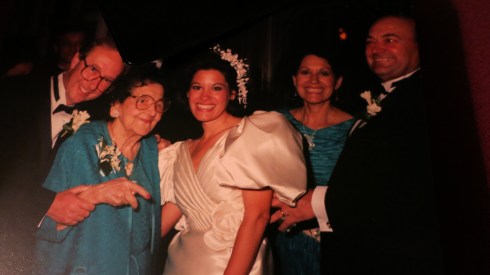
At our wedding in 1987, Len, Maude, me, my Mom and Dad (Alex and Maude’s son) 
Maude, at 92, still loved to dance!

2:00 A.M. to bed.

 Always Al

To be continued.

Ciao,
Judy
Through His Words: Day Five

8 Jan

Reflections From and About My Grandfather
Alexander Capraro, Architect

Day Five:

Wednesday, July 20, 1938 
On board ship        
Chapter 5

Darling Toots,

There is certainly a lot of water between us now. It seems there is no end to this ocean – water, water, sky and ocean.

Just how much water in distance? Approximately 7094 kilometers or 4408 miles or 3831 nautical miles.

Had breakfast and lunch today, and if I don’t gain weight on this trip, it won’t be the ship’s fault. I am being careful but the ocean air makes you eat almost anything and everything and especially tonight because they had a “Gala” night – the big night on the boat. Champaign was served and everyone had on their best clothes, paper hats, horns, and all kinds of favors. 

IMG_0003

Gala Night, Conte di Savoia; Alex 2nd from right

Interestingly, I had found this picture in my grandfather’s papers and wondered why he and three other grown men chose to wear hats with flowers at what appeared to be a semi-formal event. Fortunately, Alex took the time to write on the back of the photo:

IMG_0001

Thanks, Grandpa, for another piece of the puzzle. Love those white shoes!

The Gala night is put on by the Captain because tomorrow we will reach Gibraltar and a few of the passengers are getting off there, which makes it the last night for them on board ship.

The Rock of Gibraltar. Of course, doesn’t everyone stop there on their way to Italy?

From its website: https://www.gibraltar.gov.gi/about-gibraltar:

In the ancient times, right through the age of empires and in the global conflicts of our own century, Gibraltar has stood guard over the western Mediterranean, its unique position making it the focus of a continuous struggle for power. This spectacular rock monolith, covering a land area of about six square kilometres, is situated at the southern tip of Spain overlooking the strait to Africa. It is known as the Meeting Place of Continents.

IMG_0004

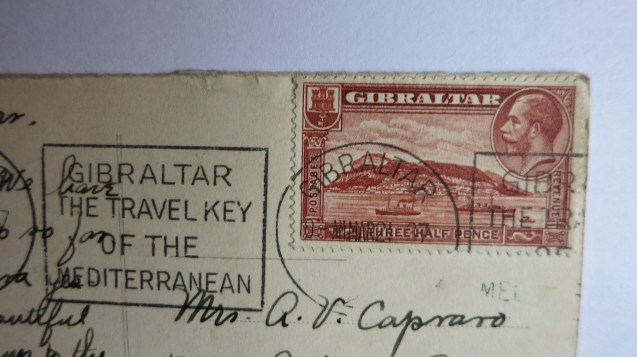
“Gibraltar – Roch From Spanish Shores”

In March, 1937, a year before Alex’s trip, Maude received this postcard from their dear friends who had visited Gibraltar on their way to Naples, just like some passengers traveling with Alex would do the next day. 

“Most beautiful place. We went to the top of the mountain and came down in a basket sled. Lots of fun. Flowers grow everywhere here. Lovely calla lilies.” (From back of postcard)

In 1713, the Treaty of Utrecht gave Britain sovereignty over the island. Today, while there are only about 30,000 inhabitants, Gibraltar is visited by over 10 million tourists per year.

IMG_0006

I spent most of the afternoon in the engine room and a well spent afternoon it was. You can’t imagine the immensity of the engines, motors, turbines etc. that are necessary to operate this oil burning ship.

The engineering side of Alex was curious. Unlike most who were more than content to admire the ship’s external beauty, Alex was equally interested in what made the ship run. How many others would be so pleased to spend most of an afternoon in the engine room? (Well, besides my husband…)

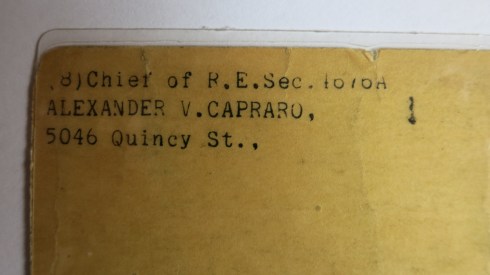
For Alex, being on Conte di Savoia was a dream come true. Its magnificent design details appealed to his architectural creativity while the ship’s inner workings coaxed his inquisitive thinking. But no wonder. Alex had been in the profession for 20 years and had built a solid reputation. 20 years earlier, after WWI, he was engaged by the Illinois Central Railroad as Chief of the Real Estate Division.

IMG_0007

IMG_0008

A few years later, in 1921, Alex entered into active practice of his profession. Then in 1926, he formed a partnership with Morris Komar, another noted architect, and founded Capraro & Komar, Architects, with offices on Washington Street in Chicago.

Well, honey, tomorrow I expect to see land again, Gibraltar, and believe me, it will be a pleasure to see what terra firma looks like after 5 days of nothing but water. I am going to walk around the deck now for a while and will write again to tell you all about Gibraltar tomorrow.

Again love and kisses to my gang.

 Always Al

To be continued.

Ciao,
Judy
Zampognari…Italian Bagpipers!

23 Dec

Zampognari Keep Alive the Tradition of Festive Bagpipe Playing

Although we often associate bagpipers with the English and Scots, did you know that bagpipers are an important part of Christmastime tradition in Italy? Read on to discover the history.

Article reprinted from Italy Magazine, Barry Lillie | Monday, December 23, 2013 – 10:00

No Italian Christmas would be complete without the sound of bagpipes. Everywhere from the piazzas of Rome to remote hillside villages, the Zampognari (pipers) continue the tradition of festive bagpipe playing that dates back to ancient Roman times.

Traditionally, the pipers were shepherds who, in a bid to earn an extra income, would travel down from their mountain homes at Christmas time to perform for the townsfolk in their markets squares. The regions where you’re most likely to see a piper are Abruzzo, Basilicata, Campania, Calabria, Molise, Puglia and Lazio.

The traditional dress of the piper is made of short breeches with criss-crossed leather leggings, sheepskin vests with a woollen cloak and peaked cap; there are regional changes such as velvet jackets or neckerchiefs, but the look of the piper remains mostly the same it has for centuries.

Legend tells us that of the shepherds who visited the Virgin Mary in Bethlehem, after gazing upon the baby Jesus, some took out their bagpipes and played. In keeping with the legend, the pipers will stop at public Nativity scenes for a few minutes of quiet contemplation.

Historically, the piper is accompanied by a shawm, a medieval woodwind instrument; however, today’s pipers are usually accompanied by an oboe player. They play traditional music, with a popular song being the Christmas hymn, Tu scendi dalle stelle (You come down from the stars), written by Saint Alphonsus Maria de ‘ Liguori, the bishop of Sant’Agata de’ Goti.

Watch the zampognari play “Tu scendi dalle stelle”:

http://youtu.be/RCEyN1pCm3E

Makes me wonder if my paternal grandfather’s ancestors played the bagpipes as Alex’s family was from Abruzzo. Perhaps someday I’ll find a photo.

Ciao,

Judy
Through His Words: Day Four

5 Dec

Reflections From and About My Grandfather
Alexander Capraro, Architect

Day Four:

Tuesday, July 19, 1938 
On board ship        
Chapter 4

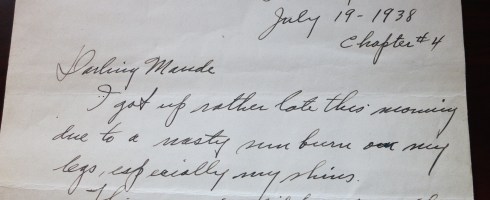
Darling Maude,

I got up rather late this morning due to a nasty sunburn on my legs, especially my shins. The sun is different on the ocean, much more intense and the salt water seems to add to its power.

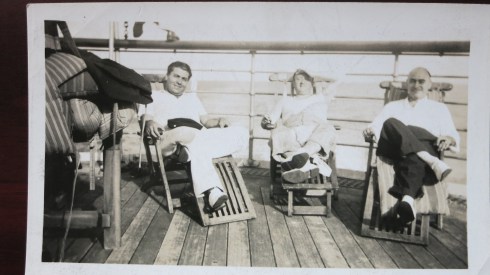
Apparently, Alex and his new friends were all a bit sunburned and decided to sit in their deck chairs fully clothed for a day.

Aboard Conte di Savoia

Aboard Conte di Savoia, Alex (right) and friends

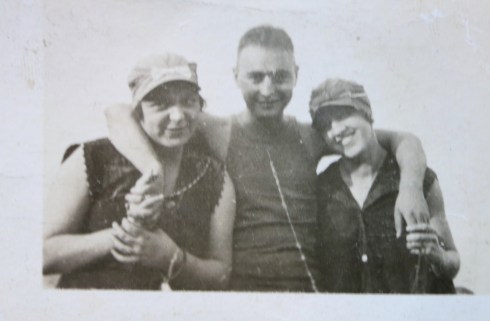
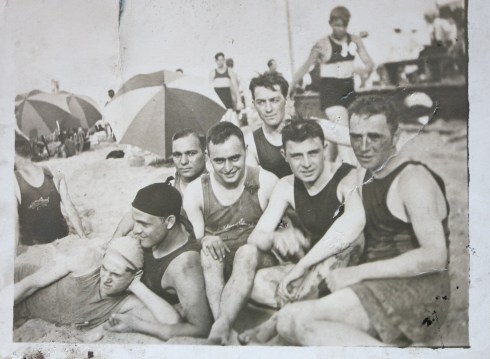
Alex loved being near water, whether it was spending time at Wilson Avenue Beach (Lake Michigan) in Chicago with Maude and friends,

IMG_0008

Maude, Alex, Margaret

IMG_0005

Alex (front center)

or heading to Paw Paw Lake in neighboring Michigan.

Paw Paw Lake: "Throw out the Life Line

Paw Paw Lake: “Throw out the Life Line” 1912

Ironically, my brother Bill bought a home on Paw Paw Lake 93 years later. Now we know what led him to that location!

This afternoon I made an inspection of the first class quarters and believe me, there is a lot of difference between 1st class and tourist class.

Alex was not extravagant, but he was very classy and did appreciate beautiful things. Sometime after they were married, he designed and built three three-flat buildings in Chicago and kept the third one for his family. It was beautiful with a sunken living room, a large dining room, three bedrooms, two baths, a butler’s pantry and a very large kitchen. Unfortunately, when the depression hit, his tenants could no longer pay rent, and he lost the buildings to the tune of more than one million dollars.

The lounges, bars, decks, swimming pool, etc., are simply gorgeous, but there are only 200 1st class passengers on board.

conte_di_savoia_5

The Grand Colonna Hall, (Steven Ujifusa)

giroscopio_conte_di_savoia2

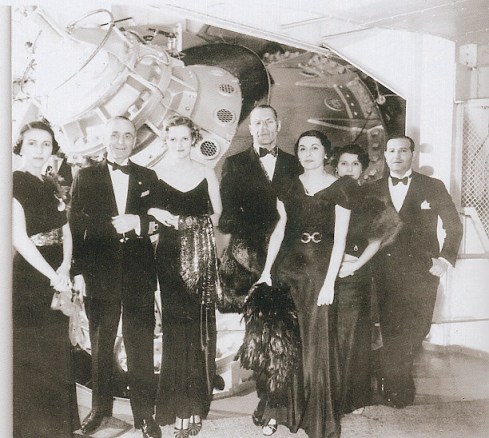
Conte Di Savoia First Class passengers in dinner dress visiting the stabilizer system – a first for trans-Atlantic liners in the 1930s.
(Cruiselinehistory.com,  Scott McBee’s New York Social Diary )

lounge

First Class Lounge, (From Scott McBee’s New York Social Diary)

I also went down to see how the other class lives (3rd class). Well, there is also quite a difference between there and tourist.

If you’ve seen the movie Titanic, you get the picture.

There was a fine time in the main lounge tonight with orchestra, dancing, and finally a great show put on by home talent, that is, the passengers. They sang, told stories, or played instruments. I did not sing “O Sole Mio” as it was murdered plenty throughout the evening by others.

O Sole Mio, translated as My Sunshine, is a globally known song written in Napoli in 1898, with lyrics by Giovanni Capurro and melody by Eduardo di Capua. It has been performed by a number of famous artists including  Enrico Caruso, Mario Lanza, Pavarotti, Andrea Bocelli, The Three Tenors, and Il Volo.

Caruso alongside his piano

Caruso alongside his piano (Photo credit: Wikipedia)

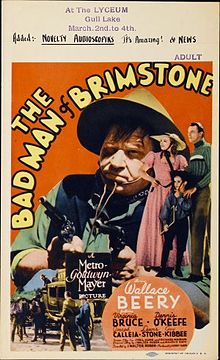
The movie tonight was “The Bad Man of Brimstone” with Wallace Barry, so I still have yet to see a new picture. 

220px-The_Bad_Man_of_Brimstone_FilmPoster

We passed through the Azores today but it was so cloudy over the islands it was almost impossible to see anything. I was quite disappointed because I could not take a picture of it for you.

Azores

Azores, (Google Photo)

The Archipelago of the Azores is composed of nine volcanic islands situated in the North Atlantic Ocean and is located about 1,500 km west of Lisbon. Quite a spectacular site – no wonder Alex was disappointed.

Tomorrow I expect to make an inspection of the engine room through permission of the offices.

Being a registered professional engineer and architect, he was certainly interested in the many parts of the ship, including the massive engine room and the stabilizers.

normal_Uno_dei_tre_giroscopi_principali_impianto_Sperry~0

Love to the children and of course you. 

 Al

To be continued.

Ciao,
Judy
To see The Three Tenors having fun with O Sole Mio, click on the link.

http://youtu.be/ERD4CbBDNI0