Archive | Italian countryside RSS feed for this section

Through His Words: Day Thirty-Six

17 Jun

Reflections From and About My Grandfather
Alexander Capraro, Architect


Saturday  August 20, 1938
(no letter written for 5 days)

Honey, I got the real kick of the whole trip today when I reached my hometown and saw the house and the actual room of my birth. It was necessary to go the opposite direction from Naples to Pietrabbondante than to Ricigliano for Rici is about 100 miles southeast of Naples and my town about 100 miles north east.
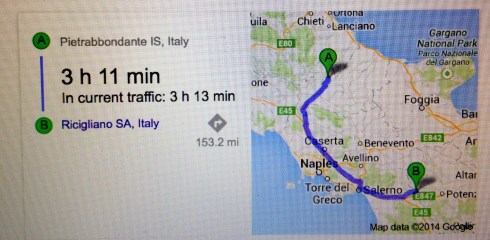
Pietrabbondante to Ricigliano today by car - Google Maps

Pietrabbondante to Ricigliano today by car – Google Maps

Alex’s parents left Pietrabbondante in 1899, when he was just four years old, to bring him to America. On the other hand, Maude’s parents and even some of her grandparents, were born in Chicago, but traced their roots to Ricigliano. Alex had promised Maude that he would visit each of their ancestral towns.

It certainly was a blessing to have the use of a car to get to these mountain towns, and when I say mountain,  I mean just that. Rici is about 2500 feet above sea level and Pietra is about 4000 feet above. Rici is almost impossible to get to it as the R.R. Station is at Bovano-Ricigliano, 10 miles from Rici, and from there, the only means of transportation is a jackass with a guide or to walk. Without a car, I never could have gone there.
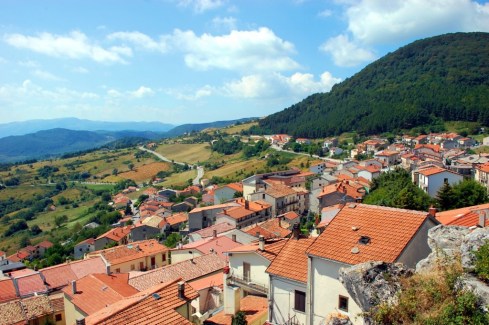
valentinadesantis.com/walking-through-pietrabbondante

valentinadesantis.com/walking-through-pietrabbondante

Joe Colianni placed the car with chauffeur at my disposal. I am paying for the gas, however, to compensate in a way for his generosity. This fella is a Chicago boy, Tony Dell Croce is his name, a nice young chap 22 years old and a marvel in those mountains. There is a lot to tell about the small towns, but today I met Rosaria’s mother, my aunt, another aunt Beatrice, and Rosaria’s other brothers and sister, two boys and one girl and a flock of near real relatives. They cried with joy in both aunts and cousins never stopped feasting their eyes on the boy from America. We took some pictures and you can see what kind of country this is, if they come out well.

I also found my relative is the big shot of the town for my Aunt Beatrice’s son is the mayor of the town and his son in turn is the priest and pastor of the church. In a few minutes, word spread that I was there and the whole town seemed to come around my aunt’s house to see the “fine automobile and the prodigal son from America.”

I went to the church climbing several hundred feet to the top of a cliff and there it was, just exactly as I had remembered it when I was a little over four years old. I went to the rear of the church and from there it is a sheer drop of a couple of thousand feet. It just makes you dizzy. From the vantage point, you can see about 20 other towns including Agnone where Doc Vitullo comes from. 
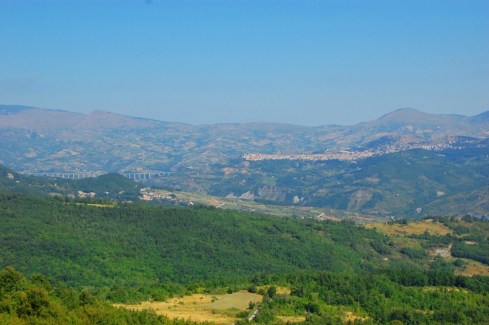
Landscape on Agnone from Pietrabbondante, valentinadesantis.com

Landscape on Agnone from Pietrabbondante, valentinadesantis.com

Now for a brief comparison. Rici has a little over 800 population, no railroad, and is practically in Calabria. 100 feet more and you would have been a Callabrian. There is one street a little over a block long and it is not paved, not even the Piazza or Square. (You must know that every town in Italy has a Piazza.) The only buildings with electric lights are the Pagano’s, the City Hall, and the church. The people are terribly poor and it’s hard to figure out how they live for there is nothing around it in the way of farmlands, etc. The crops are meager and scarce, but on these meager crops, they have to exist.
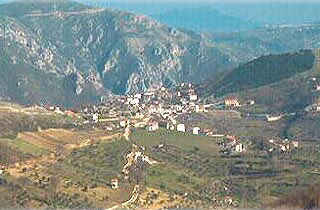
comune.ricigliano.sa.it

comune.ricigliano.sa.it

The people from my town are in a little better circumstance for besides raising wheat, etc., there is a great mountain forest with a very expensive wood as a product of the trees, and a few sawmills to cut the trees and market the lumber. The town has 4000 inhabitants, electric light, and a secondary railroad, so that it is accessible. It certainly is rightfully named for the mountain peaks of stone and rocks of marble from a wall on one side. The scenery here is beautiful beyond imagination, going to either town, but the roads are better going to Pietra than they are at Rici. I don’t say this to boast about my town; this is a fact.

Abbruzzi is quite higher in the mountains, cooler in summer and more scenic than any other part of Italy, and it is becoming a summer mountain resort catered to by people from Rome and Naples. Water there is marvelous. I must have drunk a gallon of water there today.

Well, I better quit writing about these towns. We got back to Naples about 11 o’clock and I am staying at Montenegros place tonight, for tomorrow I am to take a boat to Capri, which is an all-day trip.

Marionelli is coming in tomorrow morning from Rome and might go with me. He sent me a wire tonight and by coincidence, he is staying at the Flora Hotel in Rome where I stayed. He informed me there are four letters for me there. I wired back and told him to bring them with him.

Monday, the Coliannis are coming to Naples and we will be together and then on the ship for home.

Some wonderful postcards from Napoli circa 1938:

Napoli  1935- Via Caracciolo

Napoli – Via Caracciolo

Napoli  1937 - Nuova Palazzo RR. Paste - Lata posteriore

Napoli –  Nuova Palazzo  RR. Poste – Lata posteriore
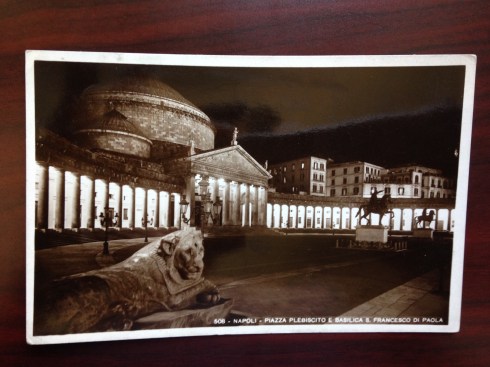
Naploi - Piazza Plebiscito e Basilical S. Francesco Di Paola

Naploi – Piazza Plebiscito e Basilical S. Francesco Di Paola

This will probably be the last letter you will get before I see you, so Goodnight Sweetheart until we meet.

Lovingly yours,
Al

Postscript:

Sadly for me, Alex’s trip has almost ended as this is his last letter from Italy. However, I am hoping in the next few weeks to visit Pietrabbondante and actually find the home of Alex’s birth, just as he did.  I have sent numerous emails to the local municipal office, and even contacted them by phone, but the fact is, I just need to show up. And thanks to Aunt Marion, I have my ancestors Italian birth records in hand!

It’s been an interesting and exciting journey for me. I have discovered so much about my grandparents lives and love, and what life was like for them in the 1930’s. The most fitting way I can think of to keep Alex’s trip alive is to keep it going.

Over the years, so much has changed in Pietrabbondante. Even the area has been redistricted and Pietrabbondante is now part of Molise instead of Abruzzo. Today, the population is less than 1000. And yet I’m sure, much remains the same. Who knows what I’ll discover?

Stay tuned as we all find out.

Ciao,

Judy


Zampognari…Italian Bagpipers!

23 Dec

Zampognari Keep Alive the Tradition of Festive Bagpipe Playing

Although we often associate bagpipers with the English and Scots, did you know that bagpipers are an important part of Christmastime tradition in Italy? Read on to discover the history.

Article reprinted from Italy Magazine, Barry Lillie | Monday, December 23, 2013 – 10:00

No Italian Christmas would be complete without the sound of bagpipes. Everywhere from the piazzas of Rome to remote hillside villages, the Zampognari (pipers) continue the tradition of festive bagpipe playing that dates back to ancient Roman times.

Traditionally, the pipers were shepherds who, in a bid to earn an extra income, would travel down from their mountain homes at Christmas time to perform for the townsfolk in their markets squares. The regions where you’re most likely to see a piper are Abruzzo, Basilicata, Campania, Calabria, Molise, Puglia and Lazio.

The traditional dress of the piper is made of short breeches with criss-crossed leather leggings, sheepskin vests with a woollen cloak and peaked cap; there are regional changes such as velvet jackets or neckerchiefs, but the look of the piper remains mostly the same it has for centuries.

Legend tells us that of the shepherds who visited the Virgin Mary in Bethlehem, after gazing upon the baby Jesus, some took out their bagpipes and played. In keeping with the legend, the pipers will stop at public Nativity scenes for a few minutes of quiet contemplation.

Historically, the piper is accompanied by a shawm, a medieval woodwind instrument; however, today’s pipers are usually accompanied by an oboe player. They play traditional music, with a popular song being the Christmas hymn, Tu scendi dalle stelle (You come down from the stars), written by Saint Alphonsus Maria de ‘ Liguori, the bishop of Sant’Agata de’ Goti.

Watch the zampognari play “Tu scendi dalle stelle”:

http://youtu.be/RCEyN1pCm3E

Makes me wonder if my paternal grandfather’s ancestors played the bagpipes as Alex’s family was from Abruzzo. Perhaps someday I’ll find a photo.

Ciao,

Judy

15,000+ Views!

31 Aug

I am delighted to report that this week, Blogginginitaly.com surpassed 15,000 views! Pretty amazing, especially as it began as a fun way for me to share our travels with family members and a few friends.

IMG_1809Over the last two years, my blog has been my journal, giving me a place to record my thoughts, experiences and pictures as we travel around Italy.

IMG_0010_2

To my surprise and delight, its reach has broadened and now includes viewers from over 80 countries.

IMG_0020 2

Many thanks for all your thoughtful comments and encouragement. Writing my blog is an endless learning curriculum for me – one that is filled with never-ending yet truly satisfying homework.

IMG_0004

It’s a joy to share my reflections about Italy with others who love it so, and a privilege to share it with those who can only dream of going.

IMG_5855

IMG_0020

I can think of no better way to say thanks than by sharing some of my very favorite views.

IMG_0020

IMG_0002

IMG_0019

And of course, let’s not forget the food!

IMG_4722

IMG_0011
IMG_0018

IMG_4262

IMG_4457

IMG_5018

IMG_0450

IMG_0457

IMG_4456
IMG_5936

Finally, to Len, with whom I have seen all of these views,

a little something we saw on a hillside…

IMG_0048

Ciao, Judy

Judy in window

Pitigliano

29 Jul

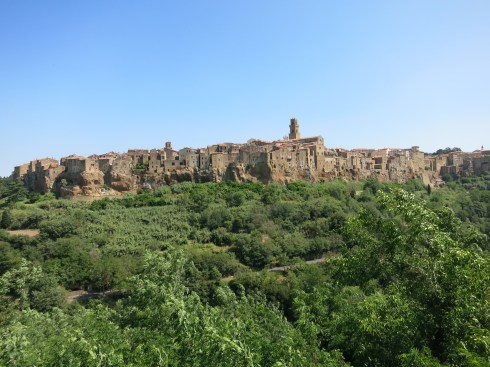
Often the word “marvel” is used to describe huge skyscrapers…modern marvels built with the latest in technological advancements, built to withstand nature’s strongest elements and built to stand the test of time. This being the case, then what word aptly describes the truest technological marvels that have more than survived nature’s strongest elements and survived for centuries? What word can we possibly use to describe places like Pitigliano, a stunning medieval town dramatically perched atop a tufa ridge?

IMG_0019

While Len and I love traveling by train and bus in Italy, one of the benefits of occasionally renting a car is the opportunity to explore the more remote areas. Situated between Roma and Firenze, and east of Grosseto, the Hills of Maremma in Tuscany is one of those areas. The Hills are filled with non-traditional Tuscan landscapes and amazing surprises around each bend.

IMG_0051

IMG_0050

IMG_0046

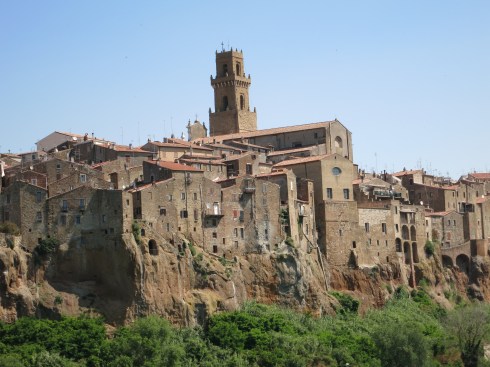
There are several towns in the area, but the most stunning to me is Pitigliano, a medieval town built on tufa or volcanic rock. When you hear medieval, think 500-1500 time frame. Houses and buildings in town are built on sheer cliffs that appear suspended over the valley, and sit above a network of caves and tunnels said to have been inhabited in prehistoric times. Fortunately, there are places to pull over as this is a photo-op must.

IMG_0020

IMG_0021

IMG_0050

In the 16th century, Pitigliano became a haven for Jews escaping enclosed ghettos in neighboring cities. Today, visitors can still see parts of the ancient Jewish Quarter; a 16th century aqueduct; a few beautiful churches; a 14th century fortress which houses a museum and medieval torture chamber; and sometimes even tour the underground tunnels and caves.

Pitigliano, Italy, at night

Pitigliano, Italy, at night (Photo credit: Wikipedia)

While only about 300 people still live in Pitigliano in southeastern Tuscany,

English: The Municipality of Pitigliano within...

The Municipality of Pitigliano within the Province of Grosseto, Tuscany, Italy (Wikipedia)

this ancient structure still stands and functions – deeming it not just a marvel, but truly marvelous!

MARVELOUS…A word befitting!

Ciao,

Judy


Valdichiana Sunsets

19 Jun

This year, Len and I have a detached salon, or summer room. It is a triangular room with a wall of windows, built upon the town wall, and separated from our house by a patio. (Windows across top are ours. Our house is to the right.)

IMG_0054We especially love to sit in the salon in the evening, share some Italian vino, recount the day’s events, and watch the entertainment over the valley.

IMG_0004

Who needs TV when we can watch moving cloud formations (no comment, Vince!), starlings, swallows, and sunsets. These are unedited pictures from last evening, from dusk to  sundown…

Sunset over Valdichiana

IMG_0001

IMG_0008

A horse and chariot race, or ancient marathon?IMG_0002
IMG_0017

IMG_0009

A dog spotting his island?IMG_0006
IMG_0005

And my favorite!

IMG_0013

From Cortona, sharing our sunsets and hoping you have time to watch your own!

Ciao,

Judy

Cortona Town Guide: Cortonaweb

10 Jun

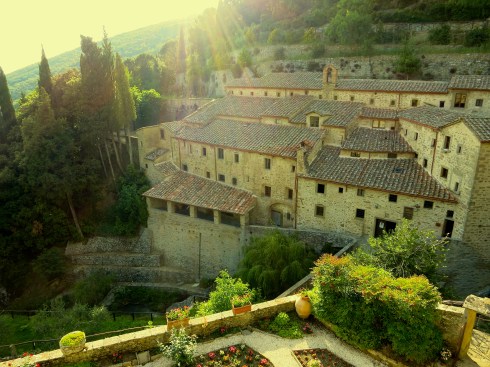
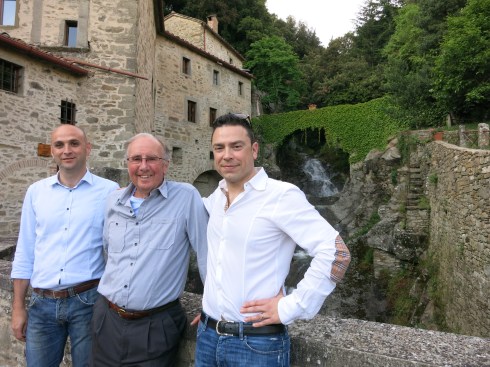
Each year in Cortona, we are fortunate to befriend more and more locals, one of the reasons we return to Cortona. This year, two of those people are Luca Tiezzi and Simone Rossi, founders and publishers of Cortonaweb.net. Pictured below with Len, they introduced us to Le Celle, one of the most beautiful places in Cortona. (Le Celle to be covered in another post!) While we knew of the monastery’s existence, we thought the grounds were private, so we never entered the monastery of St. Francis of Assisi. But for now, back to Luca and Simone and Cortonaweb.

IMG_0016_2

Len, being a business professor of Entrepreneurship, loves meeting with young entrepreneurs and discussing the challenges and opportunities they face. Here in Italy, there are many challenges for the young as unemployment  is well above 20%. With Luca and Simone, our conversations dance between English and Italian, and include everything from local and national politics, their business goals and challenges, food, wine, historical sites, travel, and whatever is happening in town. Being natives of Cortona, their depth of knowledge and appreciation of the historical area is evident, not only in their conversation but also in the relevance and thoroughness of their work.

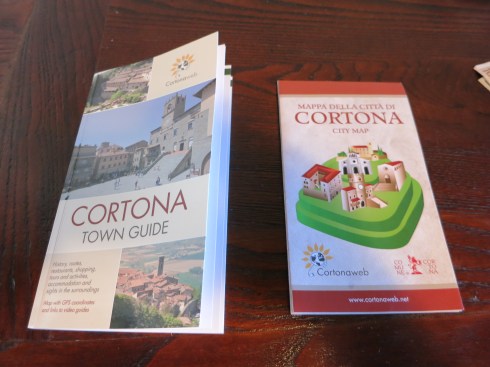
While Len and I have many books and maps on various parts of Italy, Cortonaweb is a Cortona tourist’s friend, offering a detailed website that includes local events, weather, local attractions and historical sites, and some recommendations for shopping,  dining and accommodations. While not all-inclusive, it certainly is a great place to start.  In addition, from the website, you can order a small but concise Town Guide and an interactive map with GPS coordinates and links to video guides and podcasts. The photo-filled small guide, available on Amazon through their website, is light and easy to carry, unlike so many others. If coming to Cortona, a must have!

IMG_0031

Grazie to Luca and Simone for introducing us to one of Cortona’s best treasures, Le Celle, and sharing their knowledge and expertise with us.

IMG_0031

New friends, new finds…we are always open for the unexpected as we experience all that Cortona has to offer!

Ciao,

Judy

Italian Hill Towns

7 Jun

Just returned from a two-day tour of the Italian countryside in Tuscany and Umbria where the drive was as lovely as the three ancient towns we visited.

IMG_0041

Our first stop was Citta di Castello, meaning town of the castle. Although there actually is no castle, there are stately old buildings and monuments, and of course, in the “larger” cities as least, a duomo or cathedral. The area was an ancient Roman port on the Tiber River and some archaeological remains of the port are visible in the southern part of the historical center.

IMG_0001

IMG_0002

IMG_0009

IMG_0006

IMG_0037

Eliza, at Antico Canonico where we spent the night, was most helpful in telling us about the city as well as other nearby towns which we visited the next day. Our “hotel” was originally built years ago as a home for priests. While the door to each unit is the original “cell” door, the apartment behind is simple, ample and clean. Yes, this is our apartment door!

IMG_0033

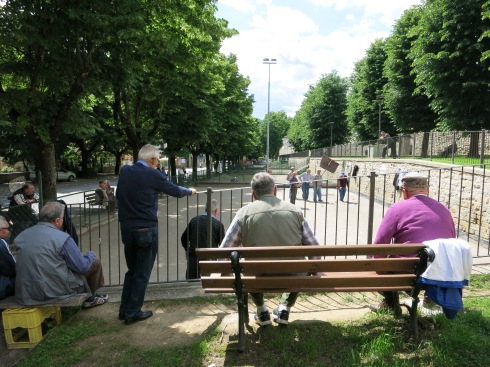
In the afternoon, we enjoyed  watching the men’s bocce tournament. And in the evening, we strolled the town with the locals.

IMG_0027

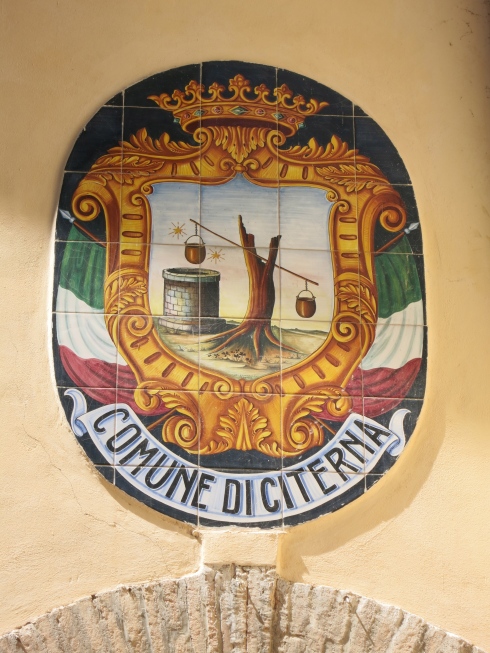
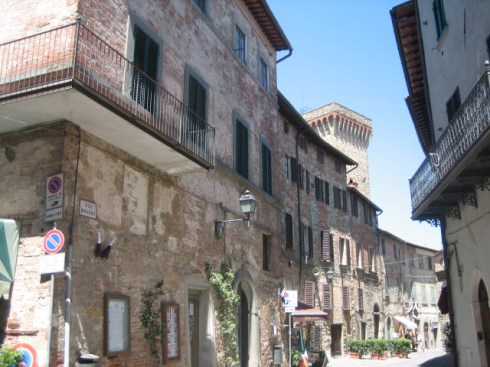
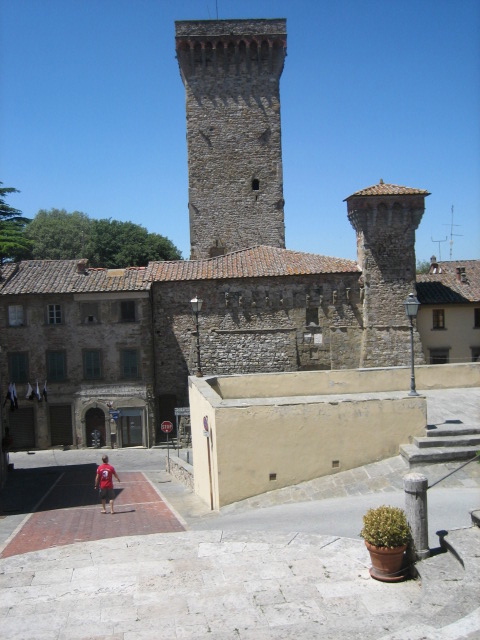
The next morning, our first destination was the lovely town of Citerna in Umbria, a tiny hilltop town which boasts of Etruscan and Roman origins and is ranked among the 100 most beautiful villages in Italy. It is the northernmost town in Umbria and while it was severely damaged during WWII, you’d  never know it today.

IMG_0014_2

IMG_0011_2

IMG_0012_2

IMG_0015_2

The panoramic views as we left town were spectacular!

IMG_0010_2

From there we headed back to Tuscany to a town called  Anghiari. At first, this appeared to be a “modern” town until we came upon the ancient hilltop walled city. Anghiari is famous for a 1440 battle between the towns of Florence and Milan, and even inspired Leonardo da Vinci to create a fresco in Palazzo Vecchio. Although the original fresco has disappeared,  a sketch of it by Peter Paul Rubens is still in existence.

Peter Paul Rubens' copy of the lost Battle of ...

Peter Paul Rubens’ copy of the lost Battle of Anghiari. (Photo credit: Wikipedia)

The ancient town is filled with steep, winding streets, and on one of them, we came across a wonderful shop called Carabattole. Sitting inside was Marinella, from whom we learned about tombolo, an art not practiced in the US.

IMG_0029_2

IMG_0027_2

IMG_0026_2

IMG_0028_2

I bought a lovely pair of earrings similar to the ones shown above. Afterward, we enjoyed a simple but wonderful lunch at a local Cantina.

IMG_0032_2

When we returned to Cortona and talked to some of the locals about our trip, many had not even heard of tiny Citerna. How lucky for us that  Eliza directed us there, as well as to Anghiari. Continuing to follow the road less travelled without agenda always brings us wonderful surprises and new memories as well as the opportunity to share them with you.

Ciao,

Judy
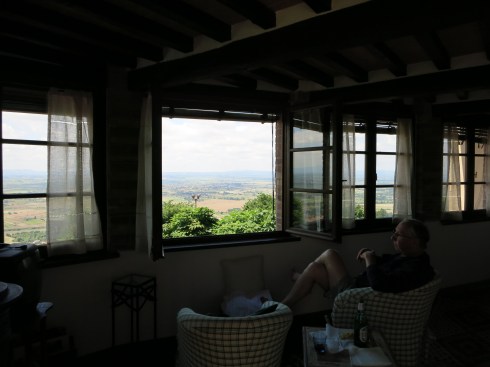
Lucignano

8 Feb

In the grey and cold days of winter, it’s fun to think about some of the beautiful hill towns of Tuscany. Lucignano, a remarkably preserved medieval walled village, is one of those towns. Laid out in elliptical rings, this beautiful town sits 414 metres above sea level and offers its visitors a trip back in time.

IMG_5963

Although Lucignano sits between Siena and Arezzo, it came under Florentine control in the 1500s, when a great deal of construction ensued. Today, one can still see the Puccini’s Fortress; Vasari’s 1568 sanctuary of Madonna della Querca; the Cappucini convent, c.1580; and several churches including Misercordia, c.1582, and Chiesa della Collegiata, c.1594.  In addition, the Museo Civico offers many artistic treasures including the L’albero della vita, or tree of life, a gilded and jeweled tree holding a crucified figure.

IMG_5976

IMG_5970

IMG_5961

IMG_5971

IMG_5972

IMG_5983

IMG_5979

In the village’s website, http://www.comune.lucignano.ar.it,  Lucignano is described as “a pearl of the valdichiana, a small village that represents one of the more extraordinary examples of medieval urban planning for its system of elliptic rings…” Today, the village continues its agricultural and artisan traditions and produces products ranging from olive oil and honey to ceramics and gold jewelry. In addition, should you wish to purchase inlaid furniture or have a piece in need of repair, the skilled artists of Lucignano are ready to oblige.

One of my favorite English signs was this:

IMG_5969

Nice People – Is that referring to the owners or a requirement for entry? It was closed so we didn’t find out.

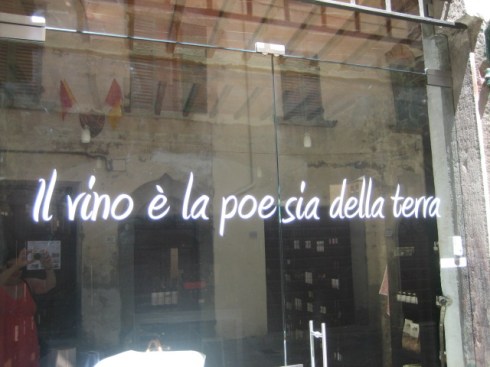
And this wonderful Italian thought:

IMG_5959

Wine is the poetry of the earth…I’ll toast to that!

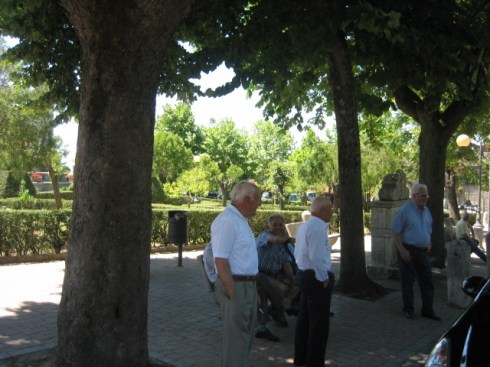
Early Sunday morning, the men all gather…

IMG_5964

IMG_5966

While the ladies smell the flowers and pick fresh basil for the feasts they are preparing…

IMG_5977

IMG_5978

A lovely way to spend a day, enjoying food, friends and family, and of course, the poetry of the earth. Just wish some of those nice people had invited us to dinner!

Ciao,

Judy

Cortona above the fog!

22 Dec

One of the most beautiful things about Cortona is that it is situated on a hillside at an altitude of over 1600 feet. This elevation provides amazing views of the valley below, called the Valdichiana. Looking out from Piazza Garibaldi, you can see Camucia, the town at the base, as well as Lake Trasimeno, the historical scene of Hannibal’s’ ambush of the Roman army in 217 BC.

IMG_6425

IMG_4840

Even on a cloudy day, the views are endless and incredible, but the winter views sent to me by my friend Pat were totally unexpected, and in her word, spectacular! My photos from last summer and Pat’s from last week were taken from the same vantage point, Piazza Garibaldi.

Valdichiana in the fog - 18 Dec 2012 4

Valdichiana in the fog - 18 Dec 2012 2

Valdichiana in the fog - 18 Dec 2012 1

Valdichiana in the fog - 18 Dec 2012 3

As Pat explains, “It happens quite often in the winter.  Camucia is in thick fog, and as you drive up the hill to Cortona, you suddenly come out of it into a different world.  It’s like being in an airplane above the clouds. Spectacular!”

With gratitude to Pat for sharing, truly spectacular, indeed!

Ciao,

Judy

5000 Views…Grazie!!!

14 Jul

WOW! Today blogginginitaly.com reached 5000 all time views! Not bad for a one year old site that started as a way to share our travels with family and a few friends. I’m humbled and honored to have so many readers and love all the feedback and comments. Just this week, I heard from a lady in Florida who will be spending a month in Cortona in the fall. She said the blog really helped her, and that is so rewarding for me. So, a huge thank you to all who have read and enjoyed the posts, especially Len and Benita! Stay tuned for more to come. For now, however, although a picture can’t truly capture the beauty, I thought I’d share a few of my favorite vistas of Tuscany. To enlarge, just click on the photo.
Ciao and Grazie!

Judy