Archive | Italian Art RSS feed for this section

David – clothed?

22 Mar
Michelangelo Buonarroti

Michelangelo Buonarroti (Photo credit: Wikipedia)

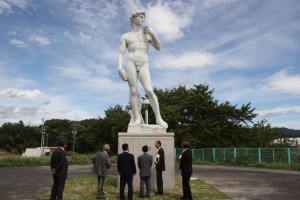
A replica of Michelangelo’s magnificent Renaissance piece, David, now stands in the town of Okuizumo, Japan. As you might expect, the marble replica of David is tall, 16 feet in fact, and also naked, as Michelangelo had intended. One would expect the town’s people to be delighted with the artistic addition,

pb-130206-pants-da.photoblog900

however, according to a town official, some of the residents are asking that David be given…underwear. Hmmm. “It is the first time we have had anything like this in our town,” said Yoji Morinaga. “Perhaps people were perplexed.”

As for me, the old adage to leave well enough alone seems to apply. However, if they are serious about clothing David after all these years,

English: Michelangelo's David (original statue...

Michelangelo’s David in the Accademia in Firenze (Photo credit: Wikipedia)

front

 (Photo credit: Wikipedia)

I would suggest the town could richly benefit from a lotto to select a seamstress!

Ciao,

Judy


Lucignano

8 Feb

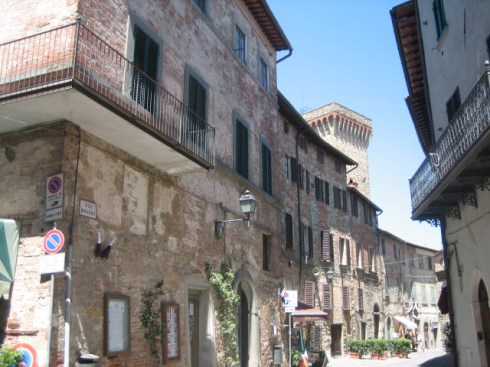
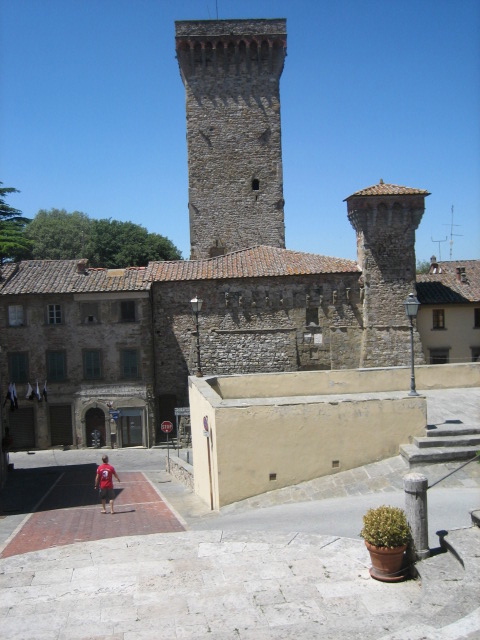
In the grey and cold days of winter, it’s fun to think about some of the beautiful hill towns of Tuscany. Lucignano, a remarkably preserved medieval walled village, is one of those towns. Laid out in elliptical rings, this beautiful town sits 414 metres above sea level and offers its visitors a trip back in time.

IMG_5963

Although Lucignano sits between Siena and Arezzo, it came under Florentine control in the 1500s, when a great deal of construction ensued. Today, one can still see the Puccini’s Fortress; Vasari’s 1568 sanctuary of Madonna della Querca; the Cappucini convent, c.1580; and several churches including Misercordia, c.1582, and Chiesa della Collegiata, c.1594.  In addition, the Museo Civico offers many artistic treasures including the L’albero della vita, or tree of life, a gilded and jeweled tree holding a crucified figure.

IMG_5976

IMG_5970

IMG_5961

IMG_5971

IMG_5972

IMG_5983

IMG_5979

In the village’s website, http://www.comune.lucignano.ar.it,  Lucignano is described as “a pearl of the valdichiana, a small village that represents one of the more extraordinary examples of medieval urban planning for its system of elliptic rings…” Today, the village continues its agricultural and artisan traditions and produces products ranging from olive oil and honey to ceramics and gold jewelry. In addition, should you wish to purchase inlaid furniture or have a piece in need of repair, the skilled artists of Lucignano are ready to oblige.

One of my favorite English signs was this:

IMG_5969

Nice People – Is that referring to the owners or a requirement for entry? It was closed so we didn’t find out.

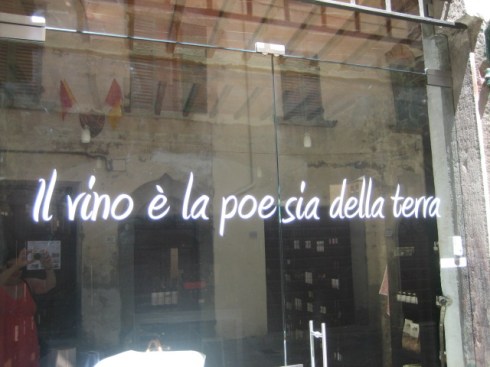
And this wonderful Italian thought:

IMG_5959

Wine is the poetry of the earth…I’ll toast to that!

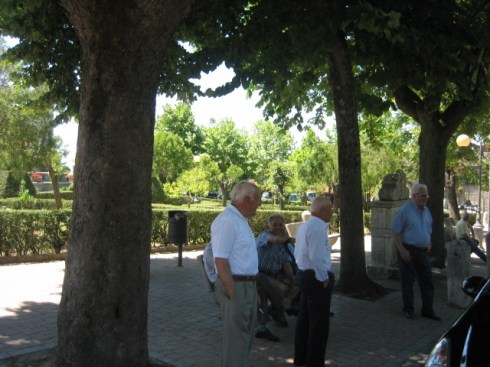
Early Sunday morning, the men all gather…

IMG_5964

IMG_5966

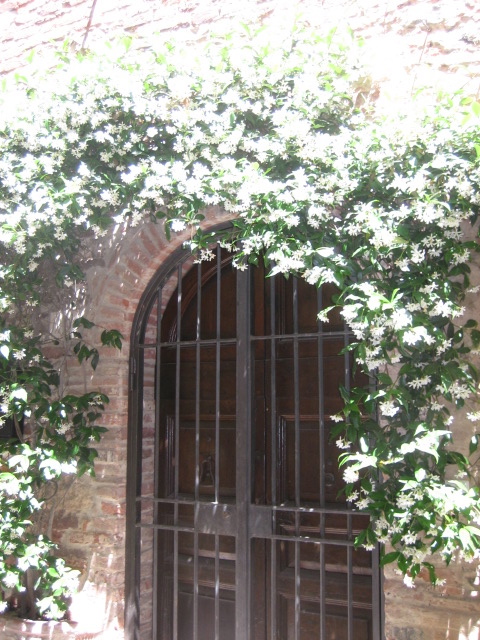
While the ladies smell the flowers and pick fresh basil for the feasts they are preparing…

IMG_5977

IMG_5978

A lovely way to spend a day, enjoying food, friends and family, and of course, the poetry of the earth. Just wish some of those nice people had invited us to dinner!

Ciao,

Judy

In the News in Rome

18 Oct

The Conflict

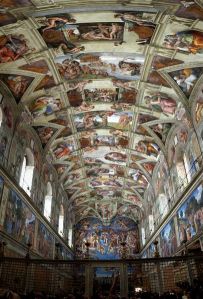
A few weeks ago, in an open letter published in Corriere della Sera, famed Italian literary critic and biographer Pietro Citati recounted his last visit to the Sistine Chapel after not visiting it for several years. In the letter, Citati essentially told the Vatican that it needed to severely limit the number of annual visitors to the Sistine Chapel. During his visit last year, Citati was appalled by what he encountered. A translation of his words shows his disgust:

“It was an unimaginable disaster. The great hall was filled with many hundreds of people: heavy jackets, coats, hats, hoods, raincoats, and umbrellas. Breaths from visitors formed halos, vapors and mists that hung at the ceiling around the Last Judgment, the Creation of Adam and the Sibyls. I believe that in a short time, it will be necessary to restore the Sistine Chapel again, and then, without some limits, gradually the heavy human breath will again fill the vast ceiling of the chapel.”

He also criticized the clapping and loud interruptions from the guards admonishing all to be silent, further inhibiting one’s ability to contemplate the majestic surroundings. Citati compared the visitors to “drunken herds” who end up confused and ultimately see nothing.

The Response

The Vatican’s response, as reported in L’Osservatore Romano, noted that five million people visit the Sistine Chapel each year to admire Michelangelo’s 16th century frescoes.  “We are now in the epoch of mass tourism, millions of people want to enjoy the culture of the past; it is a phenomenon of which we are perfectly aware and which must be faced…” The manager of the Vatican museums added “for the past two years, a study has been under way for the renewal of the ventilation system and damp control. But restricted entry is unthinkable. The Sistine is not only a place of art; it is also a consecrated chapel, a compendium of theology, and a true and proper catechism in pictures.”

A Personal Story

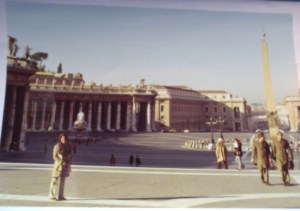
When I was a student in Rome in 1971-2, and my parents came to visit, they had scheduled a tour of the Sistine Chapel through a priest at our home parish.  Back then, there were significantly fewer tourists, so tours of this nature were not so unusual.  Note the daytime picture below of me standing outside the Vatican…it’s NEVER this empty anymore!

Judy (left) at the Vatican

As I recall, we didn’t walk through miles of halls en route to the Chapel, but entered fairly close to the Chapel itself. As our priest guide was explaining various details about paintings in the great halls to my parents, I wandered off alone and through a doorway into another room. Stunned, I looked around, then up at the ceiling…the fingers almost touching…The Creation of Adam….I was in the Sistine Chapel…alone. Truly, honestly, alone, with Michelangelo and his incredible years of work. I will never forget that moment or that sight.

Shortly after, I heard my parents’ slight gasps as they too entered this magnificent room. We stood in awe, mouths open, unable to speak. Together with our guide, we lingered with great astonishment and incredible admiration.

I have visited the Sistine Chapel several times over the last dozen years. Each time, however, the visit grew more and more crowded, noisy and frustrating, so I fully understand Pietro Citati’s concern and dismay. Noisy and sweaty tourists on smart phones stand shoulder to shoulder, often ignoring the ban on flash photography or the request for silence. And yet, limiting entry to the one of the greatest artistic creations of all time is, in the words of the museum director, unthinkable. “The time when only Russian grand dukes, English lords or experts … had access to the great masterpieces of art is definitely over.”

How does the Vatican save yet share, preserve yet provide? Somewhere between the two ends of the spectrum lies the answer. I wonder what Michelangelo would suggest.

Ciao,

Judy

A Rome Reunion to Remember!

30 Sep

There are many things that can make one fall in love with a country. I was reminded of so many of them this weekend as I celebrated the 40th reunion of my junior year abroad with many fellow “Rome Campers” at the 50th anniversary of Loyola’s John Felice Rome Center.

In the fall of 1971, 358 students, mostly from across the U.S., descended upon Loyola University of Chicago’s Rome campus.  Eager with excitement and perhaps a bit nervous about the unknown, we came together to spend our junior year in Italy. And what a year it was!

Although our classes were in English, we all studied the Italian language and became fluent enough to eat, shop, travel and carry on with the locals. Our beautiful campus on Monte Mario provided the perfect setting for our home away from home, and our teachers and classmates became our new family.

We ate, drank, socialized, studied, shared our innermost thoughts, chased our dreams, learned about new cultures, confronted our fears, and most of all, had an amazing opportunity to discover who we were and what made us tick. Most of us turned 21 that year.

Besides the classroom academics, much of our study abroad learning happened in the classroom of world travel. Over the course of a school year, and with no classes on most Fridays, travelling was easy…I visited 17 countries.

In small or large groups, spreading out in all directions like the spokes of a wheel, we ventured from Liverpool to Leningrad, from the Netherlands to the Nile, and just about every place in between.  We rode camels to the great pyramids; saw the birthplace of Jesus; toured ancient Greek ruins; visited the home town of the Beatles; hosted a Christmas day party for an orphanage; gathered on a hillside to film a Coke commercial http://soc.li/wOdW4Qf;

celebrated numerous 21st birthdays at Carmellos; wrote a letter to Pope Paul VI about Vietnam; rode Vespas throughout Rome; literally “jumped” into the Trevi Fountain (ok, it was the night before we were heading home and a few of our classmates wanted to be certain it was a memorable evening!);

marveled at the amazing art and antiquities throughout Italy and wherever our travels took us; flocked to the Vatican after the Pieta was damaged (before it was behind glass);
attended the “real” Oktoberfest and Mardi Gras; learned to eat calamari; loved to drink cappuccino; and just simply had the time of our lives.

Over the last few days, with friendships renewed and hugs abundant, many of us gathered from near and far to retell and relive the stories as if they had happened yesterday. We raised our glasses – to each other, to those who could not attend, and to those who have left us. How incredible, after 40 years, to so vividly remember each other and the events that shaped our lives that year. Sure, a few well earned wrinkles and gray hairs have emerged, but they have done nothing to lessen the sparkle in our eyes and the smiles on our faces. We loved our experiences then and still cherish them to this day. For most of us, our year together in Rome still ranks among the best years of our lives.

Saturday night, at the 50th anniversary gala, a Fiat 500 was auctioned. None of us won the car, but for sure, we all walked away winners. You don’t need to look hard to see that!

Over the last 50 years, more than 14,000 students have attended Loyola’s Rome Center. Not surprisingly, those just returning shared the same enthusiasm and reaped the same rewards as we did so long ago. At Saturday night’s grand celebration, 50 years of Rome Center attendees, aged  20’s to 80’s, gathered to celebrate. While the heels were higher and the dresses shorter for the younger generations, there was little difference in the glow of all the faces of alumni brimming with stories to share. In fact, some of our stories trumped those of the more recent attendees as they discovered we actually had birrra machines in some of our hallways!

When our class left the Rome Center in 1972, I’m sure most of us thought we’d return within a year or so. I know I did. But after college came my career and graduate school, then a wonderful marriage and family, and incredibly, it took me 25 years to return. My advice, especially to students, is to take advantage of any opportunity you may have to study abroad and learn about other parts of this world we share, whether for a year, a semester, or a summer. Careers and yet unknown responsibilities have a way of postponing your best laid plans for travel, so jump at the opportunity if you can.

To my classmates, ci vediamo a Piazza Igea, alle otto, domani mattina! Well, perhaps not tomorrow morning, but hopefully our paths will cross again soon. And thanks to all whose pictures I have copied and shared here. I can’t believe I found the commercial!

Grazie tutti for a most memorable and wonderful weekend! Campers, and spouses, you’re the best!

Ciao!

Judy

Mona Lisa Uncovered

1 Aug

Does the name Lisa Gherardini sound familiar? Well, it didn’t to me until I saw a news clip that caught my eye. Many experts believe that Lisa, the wife of Italian merchant Francesco del Giocondo, was the subject of Leonardo Da Vinci’s famous painting, Mona Lisa. Now it seems that her bones may have been uncovered beneath the altar of the Convent of Saint Ursula in Florence, Italy.

The clipping intrigued me, mostly because I’m not sure I have ever wondered who Mona Lisa was. So, a bit of research uncovered some information I found very interesting:

  • Lisa was born in Florence, Italy, in 1479, and was the eldest of seven children.
  • In 1945, at the age of fifteen, she married Francesco del Giocondo, a successful merchant. Together they had five children. Two of their daughters became nuns, (which has to do with the location of the archaeological dig!)
  • In 1503, Francesco commissioned Leonardo DaVinci to paint a portrait of his wife, Lisa, age 24. It is believed it took him about four years to complete due to other projects. DaVinci, however, feeling the painting was unfinished, never delivered it to Francesco nor did he get paid for his work.
  •  The painting depicts Lisa as a fashionable woman as well as a faithful wife of her time, as shown through her right hand over her left.
  • The title of the painting, La Gioconda in Italian and La Joconde in French, refers to Lisa’s married name Giocondo, as well as the nickname La Jocund, meaning the merry one.
  • Monna Lisa was the original title. Monna is considered a contraction for Madonna, meaning Madam or My Lady.
  • After her husband died and Lisa’s health began to fail, daughter Marietta (a nun) cared for Lisa in the convent of Saint Ursula, where she is believed to be buried.
  • King Francis I of France acquired the painting in the 16th century and kept it in his chateau, The Fontainebleau. Many years later, it was hanging in Napoleon’s bedroom in the Tuileries. In 1797, it was moved to the Louvre where it became accessible to the masses for viewing.
  • On August 21, 1911, Vincenzo Peruggia, an Italian carpenter who worked  at the Louvre, stole the painting from the wall of the Salon Carré. It was recovered 2 years later when he attempted to sell it to a Florentine antique dealer.
  • Mona Lisa is considered one of the most famous paintings in the world. About six million people visit the painting each year at the Louvre in Paris. It now hangs in the Salle de Etats, inventory number # 779. ( Great trivia!)
  • Mona Lisa is undated and unsigned.

For those who have had the joy of being in the Louvre, you might have been caught off guard by the size of the painting. For a portrait of its time, it was actually considered large. But for many today, including me, it’s hard not to be struck by the small size of perhaps the world’s most famous painting… 30 inches high by 20 7/8 inches wide (77cm by 53 cm). Nonetheless, her smile and eyes never fail to intrigue…and now we know about the hands!

As for unearthing the bones, click on the link for a great picture of the dig as well as an explanation.

http://dawn.com/2012/07/24/italian-archaeologists-close-in-on-real-mona-lisa/

Ciao,

Judy

Cortona Cathedral, Diocesan Museum and MAEC

2 Jun

The Cathedral

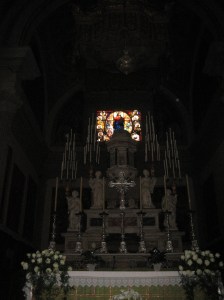
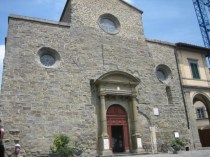
The Church of Santa Maria Assunta is considered to be one of the oldest churches in the city, built on the foundation of an ancient parish church. It is believed that the original church was built on the foundation of an ancient pagan temple dating back to the 4th century. The interior of the church was remodeled in the 18th century. With only outside lighting, it’s difficult to show much of the interior.

Cathedral altar

The Diocesan Museum

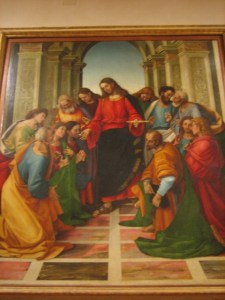
Originally built as the Church and Oratory of Gesù, between 1498-1905, the nine room Museum holds some of the most valuable religious art from Churches in and around Cortona. Included in this collection are amazing masterpieces by the local artist, Luca Signorelli, who was born in Cortona around 1455 and died in 1523.

Signorelli: Communion of the Apostles

Signorelli: Lamentation over the dead Christ

Signorelli is considered to be among the most important painters of the Italian Renaissance. The intensity of the color and the detail in his designs are breathtaking.

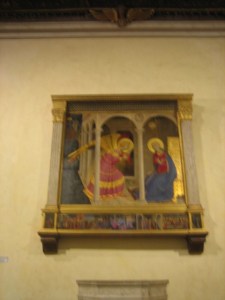
Also found in the museum is this masterpiece by Fra Angelico, the Annunciation:

Fra Angelico: Annunciation

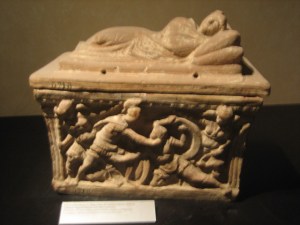
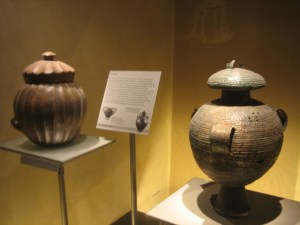
One ticket buys entrance to the Diocesan Museum as well as the Museum of the Etruscan Academy (MAEC), and it’s good for two days, so we spread our visit. And good that we did as we had no idea how much we’d find in the MAEC. Arranged in chronological order, from room to room, is the history of ancient Cortona up to the Romans, and also more current works. Looking at pieces that are over 2500 years old is mind boggling.  So much and so well preserved! Here’s a sampling.


Yes, that is gold jewelry, and nothing on the Ponte Vecchio can compare!

We are off to Rome tomorrow for three nights. I probably won’t be writing, but I will be reading so feel free to leave me comments. Mike leaves us next week…he’ll be busy in Rome and even spending a day in Pompeii with our friends Larry and Sandy, who are joining us in Rome. They are scheduled to have dinner in Naples and promise to bring us back a pizza…the best in the world!

So, Mike, farewell to you from Cortona!

Ciao,

Judy

Firenze

29 May

Just returned from two wonderful days in Firenze.

Yesterday, we took the 1.5-hour train ride from the Cortona/Camucia station, dropped our luggage at a small B&B,

Ricotta fresca

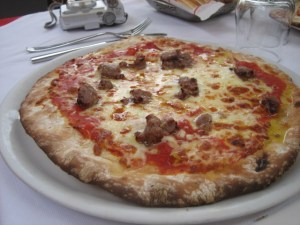
and headed to Piazza della Repubblica for lunch at Le Giubbe Rosse. The pizza was delicious and the fresh ricotta and tomatoes… simple and delicious!

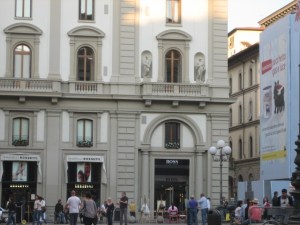
From our table, I could see the balcony of the room at the Savoy where we celebrated my parents’ 50th anniversary. On either side of the balcony is a statue – one male, one female. When I see them, I always think my parents are smiling down at us, happy that we are still celebrating their lives and the legacies they left us.

Savoy Hotel, balcony upper right

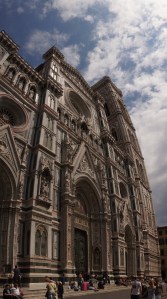
After lunch,  we walked to Piazza del Duomo, Firenze’s historical center containing the Cathedral, the Baptistery (correct spelling!) and the Campanile, or bell tower.  The magnificent façades consist of an intricate pattern of green, white and reddish pink tiles, which you can see better if you click on Benita’s photo.

Duomo facade

As summer months go, May is definitely a tourist’s paradise, especially on Mondays. Crowds are lighter as kids are still in school and the big galleries are closed, so fewer tour groups crowd the city.

That said, we were able to walk right into the Cathedral, also known as Santa Maria del Fiore. The cathedral’s dome, engineered by Filippo Brunelleschi and built between 1420-1436, is considered the most impressive feature. Benita is able to stitch shots together, providing this impressive view of the dome and altar.

Duomo altar and dome

The  Baptistery is one of the oldest buildings in Florence. Until the 19th century, all Catholics in the city were baptized in the octagon-shaped Baptistery. Some of the more notable baptisms include Dante and members of the Medici family. The bronze doors of the Baptistery include copies of 28 reliefs depicting scenes from the Bible. The originals are in the Museo dell’Opera del Duomo.

Today we had reservations (no waiting in long lines!) for the Uffizi Gallery, world renown for magnificent works of art and the Accademia, home of Michelangelo’s David. So much art and culture in one city…truly overwhelming, each and every visit.  Both galleries now prohibit any photography, but did not years ago when I was a student in Italy. I am reminded once again to pull out the hundreds of slides I took back them and convert them to current media.

On a sad note, there was another earthquake today in northern Italy. When we were at the train station returning to Cortona, they were talking about the difficulty getting to and around Bologna. Fortunately, Firenze and its treasures were not affected.

On a lighter note, at the exit of the Accademia in the garden across from the bookstore, there is a David that can be photographed. I must admit that after being in the trance that David causes, I felt the outside David was a bit sacrilegious. But since this David is provided by the museum, I guess you should  see it!

Also at the Accademia!

A wonderful trip!

Ciao,

Judy

Happy Memorial Day!

28 May

Last summer, we were here for the 4th of July and I was determined to find an American flag. I’m happy to show this photo once again.

Today, I want to include a special note and link I received from my niece, Loren. “Nice reminder on Memorial Day of the good in the world and reasons to be optimistic about and for future generations.”

Good in the world and optimism…important things to think about, especially today.

The Editor’s note below describes the link, which is well worth the read.

Editor’s note: Fareed Zakaria recently delivered the commencement address at Harvard. While the audience was graduates, the message could apply to a great many of us, so we’ve reprinted a modified version below.

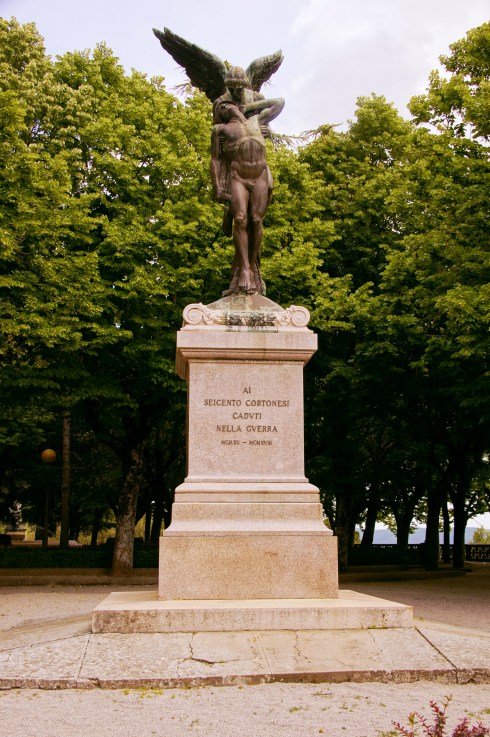
And finally, courtesy of Benita, a magnificent tribute in Cortona dedicated to those who have served. The bronze statue, by Cortonese sculptor Delfo Paoletti (1895-1975),  graces the entrance to the public gardens and depicts a soldier being lifted in the arms of an angel.  Our thoughts are also with those who continue to serve.

Cortona War Memorial

Ciao!

Judy