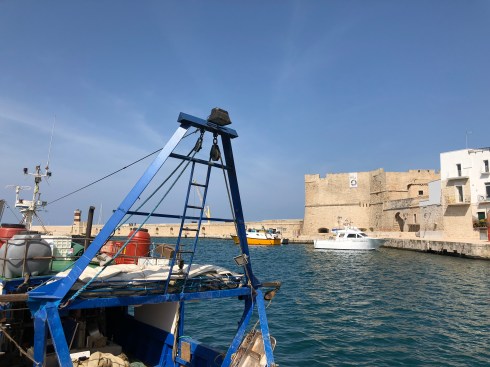
We decided a walk along the shore was the best way to choose our restaurant. The first place we came to was the fish monger who proudly displayed the morning’s fresh catch. We knew we were in for a treat.
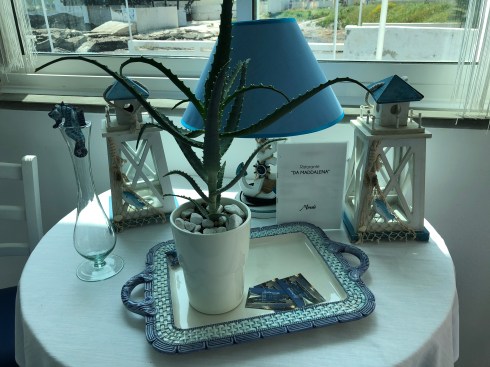
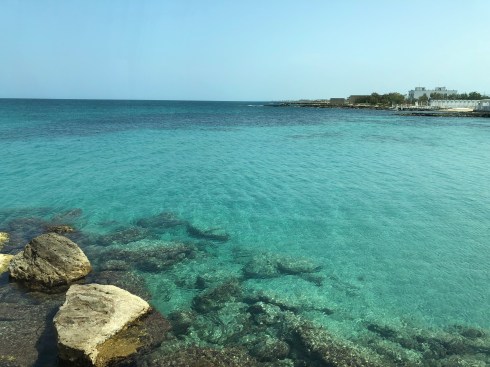
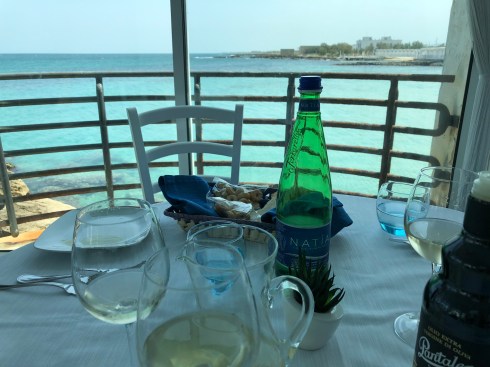
There were several places choose from, on and near the water, but we were determined to choose a restaurant right on the water. And then we found Ristorante Da Maddalena.
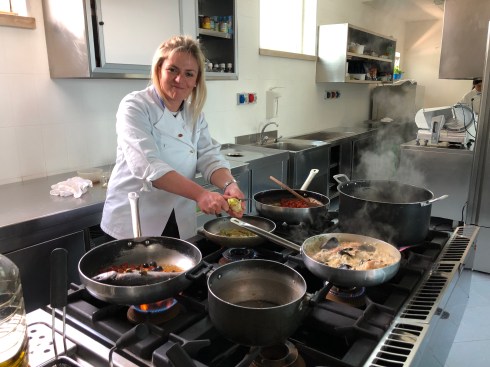
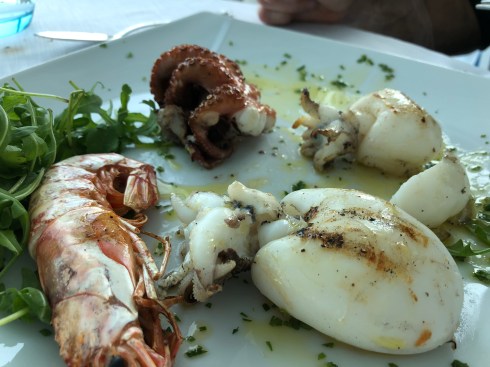
Even more than seeing the trulli, or the caves, I think this was why Len really wanted to head south. We video chatted with him, but we could never quite find the words to describe our meal. Guess we’ll have to head back south to Da Maddalena some other time!
Len and I had long wanted to visit Puglia and Basilicata, beautiful southern regions of Italy located in/near the boot. We had made plans a few months ago with friends Susan and Ray, and were all set for departure last Tuesday when Len got a flu/cold. Since our flights and hotels were non changeable, and he assured me it was nothing serious, he insisted I go. Thanks to some online video apps, Len sort of came along anyway.
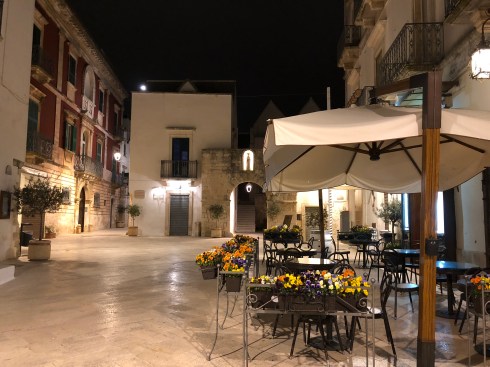
Our flight took us from Pisa, Tuscany, to Brindisi, Puglia, where we rented a car and headed to Locorotondo in Puglia for two nights. We stayed in a lovely three room B&B, Da Concavo e Convesso, and used this as a base to visit other locations.
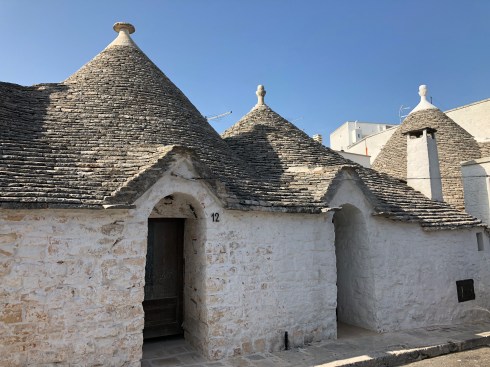
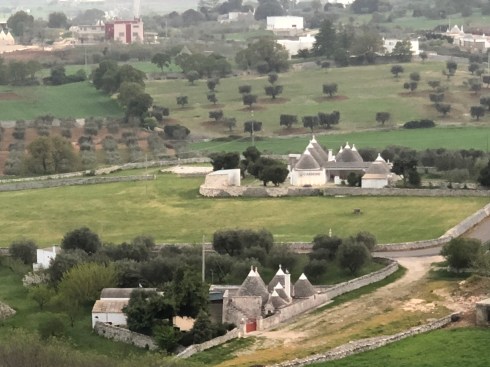
So what exactly are trulli? They are traditional dry stone huts with conical (cone-shaped) roofs.
Their style of construction is specific to the Itria Valley in the Puglia region. Trulli generally were constructed as temporary field shelters and storehouses or as permanent dwellings by small proprietors or agricultural labourers. The golden age of trulli was the nineteenth century, especially its final decades. Our destination was Alberobello, famous for its unique trull0 (singular) construction, and a UNESCO site since 1996.
According to history, peasants were sent to this land to build dry dwellings without mortar, ones that were unstable and could be easily demolished. This had to do with taxation, as dwellings deemed unstable and temporary would not be taxed, or could be dismantled quickly when tax collectors were in the area. Having to use only stones, the domes with overlapping stones proved simplest to build, but as it turned out, very solid as well.
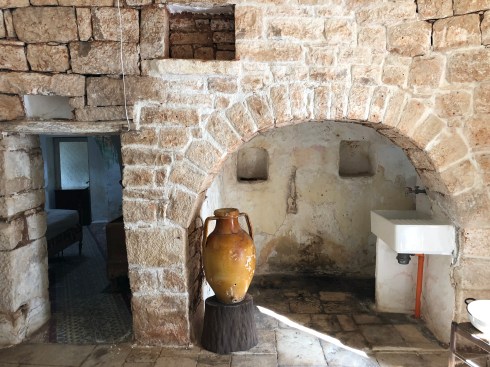
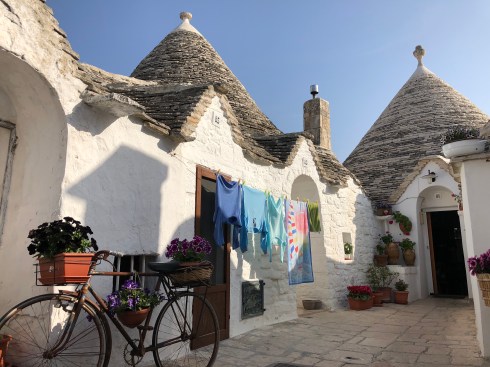
The vast majority of trulli have one room under each conical roof, with additional living spaces in arched alcoves. Children would sleep in alcoves made in the wall with curtains hung to separate them from the central room.
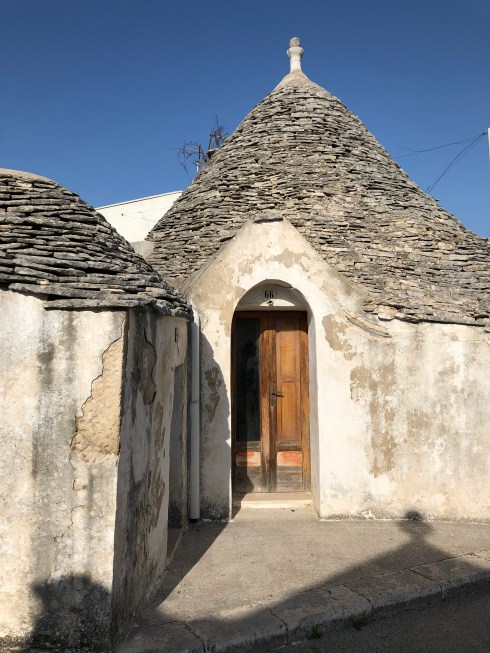
Because of the very dense concentration of houses, trulli have few openings except for their doorway and a small aperture provided in the roof cone for ventilation. As a result, they could be very dark inside. You can see here three front doors and associated addresses 42, 44 and 46, all within feet of each other.
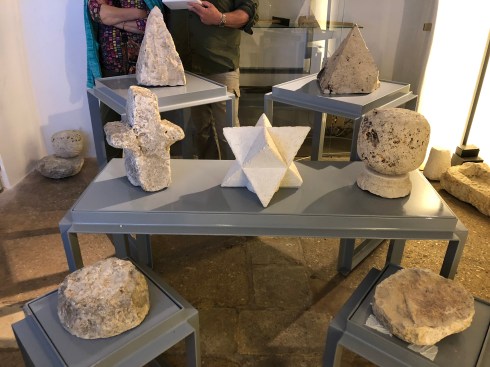
The domed roofs are embellished with various decorative pinnacles representing the master builder, restorer, or various religious, political or other symbology.
Urban trulli, which still exist in the area, date from the 18th-20th centuries. But some settlements began to be deserted during the second half of the twentieth century.
according to the UNESCO website: their highest concentration and best preserved examples of this architectural form are in the town of Alberobello, where there are over 1500 structures in the quarters of Rione Monti and Aja Piccola.
While many are occupied by locals, others have been converted to holiday houses for tourists.
I had always heard of these interesting structures, but seeing them and visiting the museum helped me better understand the life and culture of a hard-working people. It is easy to understand why the trulli of Alberobello have been designated a UNESCO World Heritage site.














 Blogging In Italy