
Pietrabbondante’s earliest known inhabitants were the Samnites, who arrived in Pietrabbondante in the 6th century BC. Many historians believe that it was the home of the assemblies of the Samnite federal government and the site is viewed as a Samnite sanctuary.
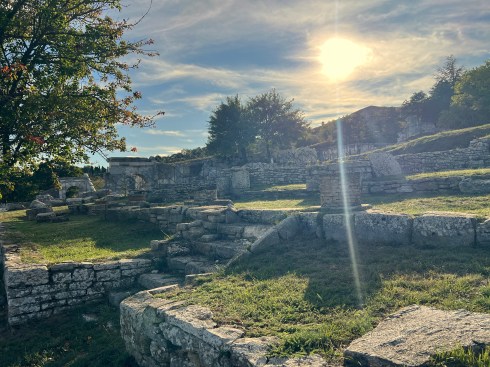
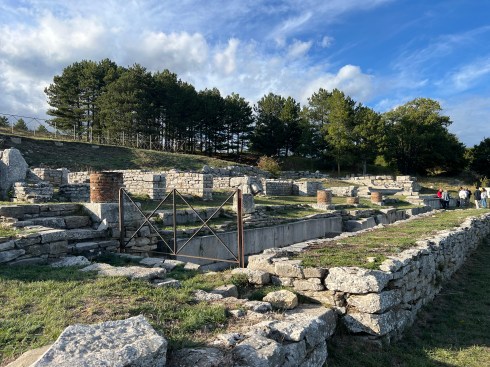
On the slope of Monte Saraceno, the Samnites built a complex of worship consisting of a theater, a temple and two arcaded buildings on both sides. Work began in the late 2nd century BC and was completed in 95 AD. The building, as articulated, was intended both for worship and for institutional activities.
©blogginginitaly.com
©blogginginitaly.com
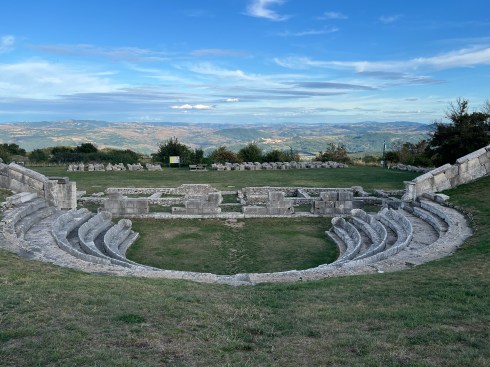
The theater-temple complex is located on the outskirts of Pietrabbondante and sits on the site of a 3rd century BC temple portico which was destroyed by Hannibal in 217 BC. To build it, the Samnites situated two terraces along the side of the mountain, but at different levels on a single axis. The theater consists of two elements: the auditorium and the building stage, which are linked together by two stone arches.

©blogginginitaly.com
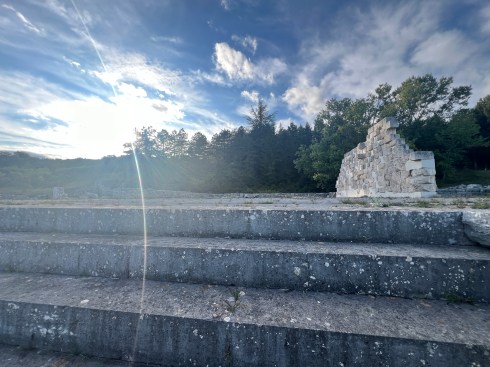
The auditorium is capable of holding up to 2,500 spectators. Each of the seats was created from a single stone block with the dorsal elegantly thrown backwards (i.e., ergonomically designed!); with signs at both ends of each row reserving them for judges, priests, and so on. On both sides of the orchestra, retaining walls of the embankment ended with supports sculpted in the form of a man, made from a kind of volcanic ash.
©blogginginitaly.com
In addition, the auditorium had and still has excellent acoustics. Our guide needed only to stand on a specific center location, then speak in a normal voice to be easily heard by all!

©blogginginitaly.com
I tried it; you can actually hear your own voice quietly in your ears and all seated around you can hear as well.

©blogginginitaly.com
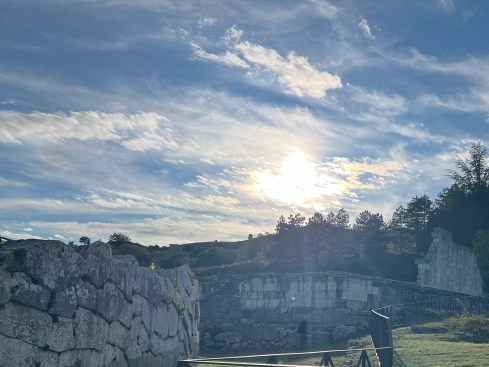
The entire embankment is supported by large semicircular and polygonal blocks processed by cutting without regular contours.

©blogginginitaly.com
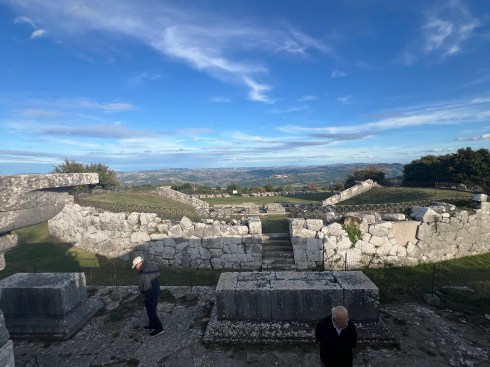
The temple, measuring 72 by 115 feet, lies behind the amphitheater. Today, the only structures remaining are the base and the eight columns that rose in front, and were paved with fine mosaics dedicated to different deities. The roof was built with trusses, stringers, plates and tiles, each weighing 115 pounds.
©blogginginitaly.com
©blogginginitaly.com
©blogginginitaly.com
The Samnites had an economy focused upon livestock and agriculture. Samnite agriculture was highly advanced for its time, and they practiced transhumance, the practice of moving livestock from one grazing area to another depending on the season. Aside from relying on agriculture, the Samnites exported goods such as ceramics, bronze, iron, olives, wool, pottery, and terracottas. Their trade network extended across Campania, Latium, Apulia and Magna Graecia, the Greek inhabited areas in south Italy. It has been written that some were envious of their abilities.
The focus of this post is the archaeological site. Historically, however, what is known is that Samnites and Romans were enemies and engaged in many wars. Roman historians believed that Samnite society was highly militaristic. They feared Samnite cavalry and infantry, and nicknamed them Belliger Samnis, which translates to “Warrior Samnites”.[5][84] It is unclear if this portrayal is accurate and some consider it propaganda. Most Roman historical accounts of the Samnites were written after the Samnite civilization disappeared as of a result of their assimilation by the Romans. What we do know is that similar to the Etruscans, the Samnites were highly sophisticated in areas such as engineering, agriculture, architecture, arts, science, commerce and more.
And now we understand why the Samnite warrior stands atop the Pietrabbondante War Memorial.

©blogginginitaly.com
Many thanks to Lino for organizing this excursion, sharing his knowledge, and giving us the opportunity to walk this incredible archaeological site. Not only did we walk these ancient lands, we also gained wonderful insights into the Samnites’ skills, innovation, determination and resilience.
Bravo Lino!

©blogginginitaly.com (Lino lower left)
Pleae note, the text in this post is mostly from Wikipedia, and underlined words link to additional info, if interested. All photos are blogginginitaly.com.
Ciao,
Judy





 Blogging In Italy